

A Climate Tipping Point Early Warning System
How a New Framework Reveals When Earth’s Climate Is Approaching Points of No Return

Clinton Alden
The KOSMOS Institute of Systems Theory
May 2026
Understanding the Risk We Face
Climate change presents many dangers, but perhaps none more consequential than tipping points. These are thresholds in Earth’s climate system where a small additional push can trigger large, irreversible changes that unfold over decades or centuries. Once crossed, these thresholds cannot simply be reversed by reducing emissions. The system has fundamentally changed state.
Consider the Atlantic Ocean’s circulation system, which moves warm water north and cold water south like a massive conveyor belt. This circulation helps keep Europe warm and influences weather patterns across three continents. Scientists have warned for years that this system could weaken or even shut down if global temperatures rise too much. But until now, we have lacked a reliable way to know how close we are to that threshold or when we might cross it.
The challenge extends beyond ocean circulation. Ice sheets in Greenland and Antarctica could reach points where their collapse becomes unstoppable, committing future generations to meters of sea level rise. The Amazon rainforest could transition to savanna. Arctic permafrost could release vast amounts of greenhouse gases as it thaws. Each of these systems has a tipping point, and each would profoundly alter our world.
This paper introduces a new approach to monitoring these risks. Drawing from fundamental principles about how complex systems maintain stability, we have developed what amounts to an early warning system for climate tipping points. The system is based on a simple but powerful insight: we can measure how well Earth’s climate is maintaining itself within the conditions that have made human civilization possible. When that ability starts to fail, we have quantitative evidence that tipping points are approaching.
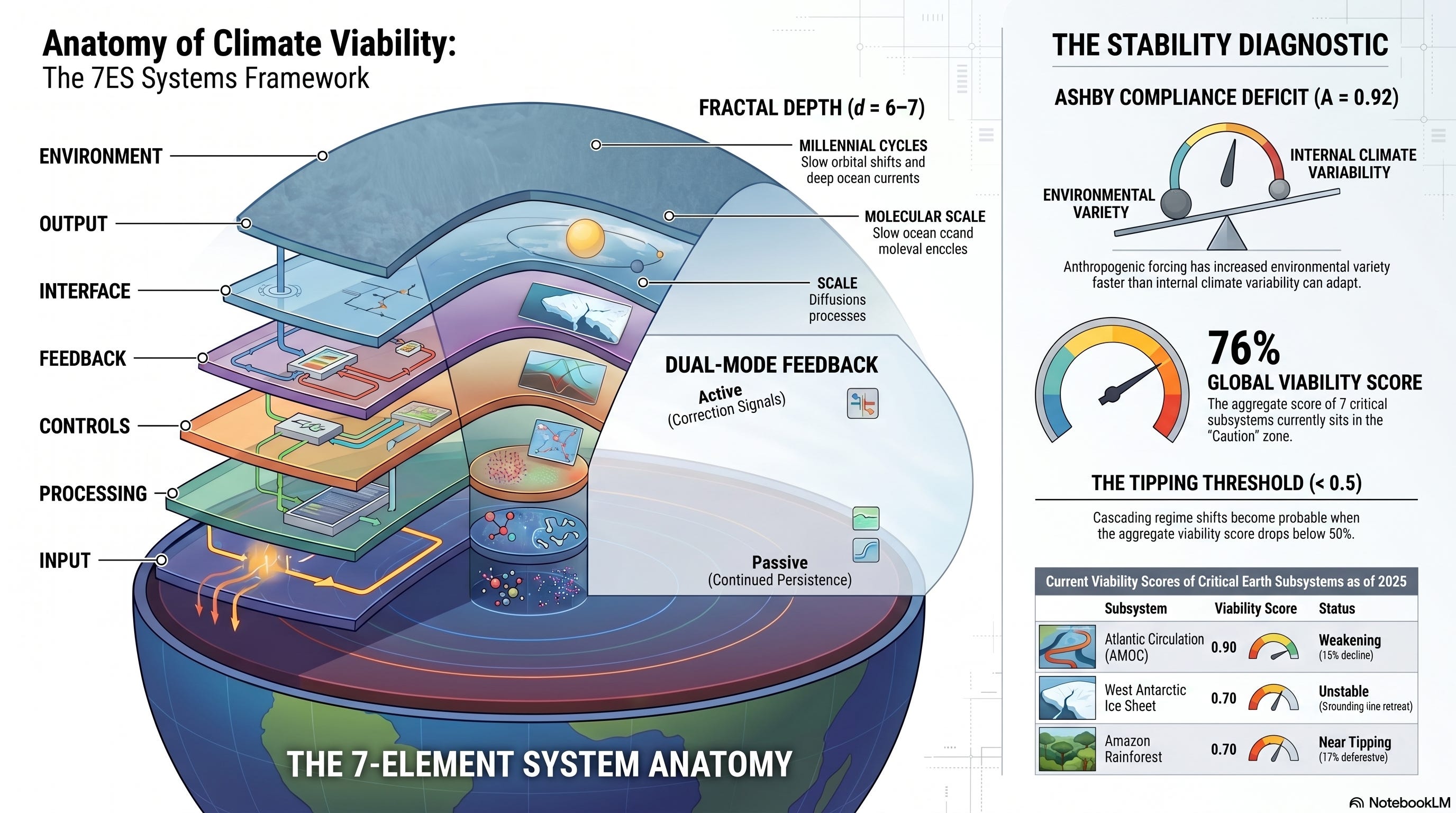
The news this system delivers is sobering. Our current measurement shows Earth’s climate operating at approximately seventy-six percent viability, meaning multiple critical systems are approaching their thresholds. Under current emission trajectories, we project this score will decline to fifty percent by mid-century, the point at which cascading tipping points become probable. However, the same framework that reveals this risk also shows what actions would reverse the trend.
Why Predicting Tipping Points Has Been So Difficult
Climate scientists have long understood that tipping points exist. Research over the past two decades has identified roughly nine major climate systems that could undergo abrupt, irreversible changes. These include the ocean circulation mentioned earlier, major ice sheets, tropical rainforests, and other systems critical to maintaining climate stability.
The difficulty has been knowing when these transitions might occur. Climate models can show that a system might be vulnerable, but they struggle to predict the precise threshold or timing. This limitation exists for a fundamental reason that goes beyond computing power or data availability.
Traditional climate modeling focuses on tracking how systems respond to changes in temperature, carbon dioxide levels, and other variables. Models calculate how much warming might occur from a given amount of emissions, or how much ice might melt at certain temperatures. What they do not adequately capture is something more basic: the overall ability of the climate system to maintain stability when faced with rapid changes.
Think of it this way. Imagine trying to predict when a table will collapse by measuring the load you place on it. You could track how much weight you add and how much the table bends. But what you really need to know is whether the table’s structural integrity is sufficient to handle the variety of stresses you are applying. If you add weight faster than the table’s structure can redistribute forces, collapse becomes likely regardless of the table’s theoretical maximum capacity.
Earth’s climate faces a similar challenge. The system must absorb and respond to an enormous variety of changes happening simultaneously. We are not just warming the planet uniformly. We are altering temperatures at different rates in different regions, changing precipitation patterns, modifying ocean chemistry, transforming land surfaces, and introducing entirely new combinations of atmospheric conditions. The climate system has internal processes that normally absorb these changes and maintain overall stability. But when the rate and variety of changes exceeds what those processes can handle, the system loses its ability to self-regulate. That is when tipping points become dangerous.
This insight comes from a principle in systems theory called the Law of Requisite Variety, first articulated by cybernetician W. Ross Ashby in the nineteen fifties. The law states that a system can only maintain stable regulation if its internal variety of responses matches or exceeds the variety of challenges it faces from its environment. When environmental variety grows faster than internal capacity to respond, regulatory failure follows.
Applied to climate, this principle reveals something current models largely miss. The problem is not just how much we have warmed the planet. The problem is that we have increased the variety and rate of changes far beyond what climate processes evolved to handle. Earth’s climate maintained stable regulation for eleven thousand years not because the planet never experienced change, but because changes occurred slowly enough and in combinations familiar enough that natural regulatory processes could respond effectively. We have disrupted that balance.
A New Way to Measure Climate Stability
The breakthrough that enables our early warning system comes from reconsidering what feedback means in climate science. Scientists have long studied climate feedbacks, the processes that either amplify or dampen warming. Water vapor feedback amplifies warming because warmer air holds more moisture, and water vapor itself is a greenhouse gas. Ice-albedo feedback amplifies warming because melting ice exposes darker surfaces that absorb more sunlight. Carbon cycle feedbacks dampen warming as oceans and forests absorb excess carbon dioxide, though these processes are beginning to saturate.
These are examples of what we call active feedback. They involve explicit signals or processes that respond to changes. When temperature rises, water vapor increases. When ice melts, albedo changes. The relationship is direct and measurable.
But there exists another form of feedback that climate science has largely overlooked, despite its fundamental importance. We call this passive feedback, and it is simply the continued persistence of a system within the range of conditions where it remains viable. A system’s mere continued existence within its historical operating range is itself information. It confirms that internal regulatory processes are still adequate to maintain stability.
Consider the Atlantic circulation again. For thousands of years, this system has moved between fifteen and twenty-five sverdrups of water per second. A sverdrup is a unit of flow equal to one million cubic meters per second, giving a sense of the massive scale involved. The circulation has fluctuated within this range in response to natural variations in winds, freshwater input from rivers and ice melt, and other factors. The fact that it has remained within this range is passive feedback. It tells us the system’s regulatory capacity has been sufficient to handle the variety of conditions it has faced.
Now imagine the circulation weakens to seventeen sverdrups and continues declining by point-two sverdrups per decade, as current measurements show. It remains within its historical range but is approaching the lower boundary. At fifteen sverdrups, we reach the edge of the viability envelope. Below that threshold, the circulation may no longer have sufficient strength to maintain itself. Passive feedback would flip from present to absent. The system would have crossed its tipping point.
This distinction between active and passive feedback proves critical for early warning. Active feedbacks tell us how the system is responding to current conditions. Passive feedback tells us whether the system is maintaining itself within viable conditions. When passive feedback begins to fail, we have direct evidence that regulatory capacity is becoming insufficient. We are approaching a boundary beyond which the system cannot sustain itself.
How the Early Warning System Works
Our early warning system tracks passive feedback across seven major climate subsystems currently approaching their viability boundaries. For each subsystem, we define its viability envelope based on historical ranges and physical constraints. We then calculate a viability score between zero and one, where one indicates the system is well within its viable range and zero indicates it has exited that range.
The seven subsystems we monitor are the global temperature envelope that has characterized the Holocene epoch, Atlantic Ocean circulation, Arctic sea ice, the Greenland ice sheet, the West Antarctic ice sheet, the Amazon rainforest, and Arctic permafrost. Each represents a critical component of climate stability, and each is approaching conditions it has not experienced in thousands to millions of years.
For global temperature, the viability envelope is straightforward. Over the past eleven thousand years of the Holocene, global average temperatures have varied within about two degrees Celsius of pre-industrial levels. Human civilization developed entirely within this range. Agriculture, water resources, ecosystems, and coastal settlements all adapted to Holocene conditions. At present, we have warmed one point three degrees above pre-industrial temperatures, giving a viability score of point eight. We remain within the envelope but are approaching its boundary.
Atlantic circulation currently measures approximately seventeen sverdrups, down about fifteen percent from mid-twentieth century levels. With a lower viability boundary around fifteen sverdrups, we calculate a score of point nine. The system remains functional but with shrinking margin. Projections suggest that without intervention, the circulation could reach its threshold within fifteen to twenty-five years.
Arctic sea ice extent in September, the annual minimum, has declined from six to eight million square kilometers in the nineteen eighties to approximately three point five million square kilometers today. The viability threshold is around one million square kilometers, below which summer sea ice could disappear entirely and trigger strong amplifying feedbacks. Current score: point eight.
The Greenland ice sheet loses approximately two hundred eighty gigatons of ice per year, well beyond historical natural variation of plus or minus one hundred gigatons annually. Current viability score: point seven. The West Antarctic ice sheet shows sectors already in unstable retreat, particularly the Pine Island and Thwaites glaciers, where grounding lines are moving backward and accelerating ice flow to the ocean. Score: point seven.
The Amazon rainforest has experienced roughly seventeen percent deforestation. Studies suggest the system could reach a tipping point at twenty to twenty-five percent deforestation combined with continued warming, beyond which the forest would begin transitioning to savanna. Score: point seven. Arctic permafrost is thawing at rates of point three to point six degrees Celsius per decade. As it thaws, it releases carbon dioxide and methane, creating a positive feedback that accelerates warming. Score: point seven.
We combine these seven scores into an overall climate viability score by simple averaging. As of twenty twenty-five, Earth’s climate viability measures approximately point seven six, or seventy-six percent. This single number encapsulates the state of multiple critical systems and provides a clear metric for tracking whether we are moving toward or away from dangerous tipping points.
The value of this metric becomes apparent when we consider its trajectory. A viability score above point nine suggests all monitored systems remain well within safe operating ranges. Between point seven and point nine, we enter a caution zone where some systems are approaching boundaries but immediate tipping is not imminent. Between point five and point seven represents a warning zone where multiple systems are near their thresholds and cascading failures become possible. Below point five indicates emergency conditions where tipping cascades are probable or already underway.
At point seven six, we are in the caution zone but trending downward at approximately point zero-five to point one per decade. If this rate continues, we would reach the warning zone by the twenty thirties and potentially cross into emergency conditions by mid-century. This timeline aligns with and helps explain the increasing frequency of climate extremes, the accelerating loss of ice, and the growing concern among climate scientists about near-term tipping points.
What Drives Systems Toward Their Tipping Points
Understanding why viability scores are declining requires examining what has changed about Earth’s climate over the past seventy-five years. The answer lies not just in how much we have warmed the planet, but in how dramatically we have increased the variety and rate of changes the climate system must absorb.
Before industrialization, Earth’s climate faced variability from solar cycles, volcanic eruptions, and orbital variations that play out over tens of thousands of years. These natural changes occurred within ranges the climate system had experienced for millions of years. Internal regulatory processes like ocean heat uptake, ice-atmosphere feedbacks, and the carbon cycle could respond effectively because the variety of changes remained within the system’s evolved capacity to regulate.
Human activities have transformed this situation. We now inject forty billion tons of carbon dioxide into the atmosphere each year, altering not just the total amount but creating entirely new combinations of greenhouse gas concentrations, aerosol pollution, and land surface changes. We are conducting approximately one thousand different combinations of emission scenarios, technology pathways, policy responses, and land use patterns globally. Each combination represents a slightly different forcing on the climate system.
The mathematical framework underlying our early warning system, derived from Ashby’s Law of Requisite Variety, allows us to quantify this change. We can estimate that environmental variety faced by the climate system has increased by roughly one million times since nineteen fifty. This does not mean the climate is one million times warmer. It means the number and rate of distinct changes the system must regulate against has exploded by that factor.
Meanwhile, the climate system’s internal variety of regulatory responses has remained essentially constant or slightly declined as some systems like Arctic sea ice lose their capacity to buffer changes. The result is that the ratio of internal regulatory capacity to environmental variety has fallen from approximately one point zero-five to point nine-two. When this ratio exceeds one, the system can maintain stable regulation. When it falls below one, regulatory capacity becomes insufficient and tipping points approach.
This is the fundamental mechanism driving declining viability scores. It is not that individual systems are simply getting warmer or receiving more stress. It is that the rate and variety of changes now exceed what natural regulatory processes can absorb. The climate system is losing its ability to maintain itself within the conditions that have characterized the Holocene and enabled human civilization.
Implications for Policy and Action
The early warning system provides clear guidance for policy. The goal must be to reverse the decline in climate viability and restore it above point nine, well into the safe zone. This requires addressing the root cause: the explosion in environmental variety driven by rapidly increasing and diversifying emissions.
The primary lever available is immediate, binding limits on greenhouse gas emissions. Our analysis indicates that reducing emissions by fifty percent by twenty thirty and reaching net-zero carbon dioxide emissions by twenty fifty would stabilize environmental variety and begin reducing it. This would halt the decline in viability scores and potentially begin recovery by the twenty sixties.
These targets are not arbitrary. They correspond to the carbon budgets consistent with limiting warming to one point five or two degrees Celsius, but the framework adds urgency by showing that the path to those temperatures matters as much as the destination. Slow, steady reductions allow natural regulatory processes time to adapt. Continued rapid increases in emissions variety, even if total warming ends up the same, increase the likelihood of crossing tipping points during the transition.
Secondary actions involve protecting and enhancing the climate system’s internal regulatory capacity. This means preventing the loss of systems that currently buffer changes. Protecting forests maintains their carbon sink function and moisture recycling capacity. Reducing non-carbon-dioxide greenhouse gases like methane provides multiple benefits including slowing the rate of Arctic warming and permafrost thaw. Protecting ocean circulation through management of Arctic freshwater inputs could provide crucial time before Atlantic circulation reaches its threshold.
The framework also clarifies where geoengineering proposals fit. Solar radiation management, the idea of reflecting some sunlight to cool the planet, would address temperature but not the underlying variety crisis. Carbon dioxide would continue accumulating, ocean acidification would continue, and the mismatch between internal regulatory capacity and environmental variety would worsen even as temperatures stabilized. This explains the growing scientific consensus that solar geoengineering is at best a temporary emergency measure, not a solution.
Carbon dioxide removal, in contrast, directly addresses the variety problem by drawing down atmospheric carbon dioxide and reducing the forcing variety the climate system faces. The framework suggests that large-scale carbon removal will likely prove necessary not just to achieve net-zero emissions but to restore climate viability after overshoot.
Most importantly, the viability score provides a clear target and timeline for policy. Rather than debating whether two degrees or one point five degrees is the right goal, we can state plainly that maintaining climate viability above point seven and preferably above point nine must be the objective. Rather than arguing about distant emission goals for twenty-hundred, we can identify that allowing viability to reach point five by mid-century would likely trigger cascading tipping points that no amount of later emission reductions could reverse.
The Path Forward
The existence of a quantitative early warning system changes the nature of climate policy discussions. We now have a metric that synthesizes complex information about multiple systems into a single trackable number. We can monitor this number annually using existing observational systems. We can set policy thresholds that trigger specific responses as scores decline. We can evaluate whether current policies are adequate by projecting future viability scores under different scenarios.
International climate agreements could incorporate viability monitoring directly into their frameworks. The Paris Agreement currently asks countries to submit emission reduction pledges every five years and ratchet up ambition over time. This structure could be strengthened by adding an explicit viability target. If monitoring shows scores declining below point seven, automatic provisions could trigger emergency acceleration of emission reductions and deployment of carbon removal.
Financial markets and risk assessment could also incorporate viability scores. The insurance industry already recognizes that climate change creates mounting liabilities through extreme weather, sea level rise, and other impacts. Viability scores provide an additional lens on systemic risk. A score of point seven six with a declining trend indicates that the probability of crossing major tipping points within thirty years is substantial and rising. This should factor into long-term financial planning, infrastructure investment, and risk pricing.
For the public and policymakers, the viability score offers something that has been lacking in climate communication: a clear, interpretable indicator of overall climate stability that reflects both current conditions and near-term risks. Opinion polls consistently show that people support climate action but often feel uncertain about urgency or effectiveness of different approaches. A score declining from point eight to point seven six over a decade, with projections showing continued decline to point five by mid-century, communicates both the seriousness of current trends and the timeframe for action more effectively than abstract temperature targets or carbon budgets.
The framework also identifies specific systems to monitor most closely. Of the seven subsystems tracked, three currently show viability scores at or below point seven: Greenland ice sheet, West Antarctic ice sheet, and Amazon rainforest. These deserve enhanced monitoring and potentially targeted interventions. For the Amazon, this means strengthening protections against deforestation and investing in restoration. For ice sheets, this means better understanding of marine ice sheet instability and potentially researching interventions like artificial ice shelf buttressing, though such approaches remain speculative.
Perhaps most importantly, the early warning system makes clear that we still have agency. A viability score of point seven six is not a guarantee of catastrophe. It is a warning that current trajectories lead toward tipping cascades within decades, and that trajectory can still be changed. The same framework that reveals the risk also shows what actions would restore viability: rapid emission reductions beginning now, protection of natural regulatory systems, and eventual large-scale carbon removal to reverse overshoot.
Conclusion
Earth’s climate is losing its ability to maintain the stable conditions that have characterized the past eleven thousand years and enabled human civilization. Multiple critical systems are approaching thresholds beyond which they will undergo irreversible changes. We have developed an early warning system that tracks this process through a single metric: the climate viability score, currently at approximately point seven six and declining.
This score reflects the fundamental challenge we face. We have increased the variety and rate of changes to the climate system far beyond what its natural regulatory processes evolved to handle. The result is approaching tipping points in ocean circulation, ice sheets, forests, and other critical systems. Each additional year of high emissions drives the viability score lower and increases the probability of crossing multiple tipping points in the coming decades.
The framework also shows the path forward. Rapid emission reductions, protection of natural climate regulatory systems, and eventual carbon dioxide removal can reverse the decline in viability scores and restore climate stability. The actions needed are well understood and technically feasible. What has been lacking is sufficient urgency and political will.
A quantitative early warning system changes that dynamic. We no longer need to argue about whether the risk is real or when action becomes necessary. The viability score provides an objective measure that anyone can track. When it declines, we know the climate system is losing regulatory capacity and tipping points are approaching. When policies succeed in bending the curve upward, we have evidence of progress.
We have roughly twelve years of remaining carbon budget for a two-thirds chance of limiting warming to one point five degrees Celsius. We have approximately twenty-five years before current trajectories would drive climate viability below point five, the threshold for probable tipping cascades. These numbers are not predictions of doom. They are measures of available time to implement solutions we already possess.
The early warning system sounds the alarm. The question now is whether we will heed it.
Technical Note
This paper presents findings from the Seven Element Structure framework for complex systems analysis, developed by the KOSMOS Institute of Systems Theory. The framework applies fundamental principles from systems theory and cybernetics to climate science, with particular emphasis on Ashby’s Law of Requisite Variety and the distinction between active and passive feedback mechanisms. Full technical documentation, including mathematical formulations, model adequacy criteria, and detailed subsystem analyses, is available in the companion technical reference “7ES Framework: Climate Science Reference v1.0.” Researchers interested in replicating the viability calculations or applying the framework to additional climate subsystems may contact the author at climate@thekosmosinstitute.org.
About the Author
Clinton Alden is Principal Investigator at The KOSMOS Institute of Systems Theory, where he develops applications of universal systems architecture to complex challenges including climate change, organizational dynamics, and technological risk assessment. His work bridges theoretical frameworks from cybernetics and systems science with practical applications in policy and decision-making.
Update: Added Infographic. CAlden 5-05-2026
I love this. Its so relevant. Feedback is so important to functioning systems.