


1. Executive Summary
The electron (ē) is the smallest fundamental subatomic particle (point-like, <10⁻¹⁸ m), scoring as a perfect natural system (FDP=10.0, DQD=0.0, OCF=0.0). Key findings:
7ES Structure: A fractal of quantum field interactions.
Perfect Scores: Closed-Loop Materiality (10.0), Emergent Transparency (10.0).
Cosmic Role: Mediates all chemistry, electromagnetism, and quantum coherence.
2. 7ES Breakdown
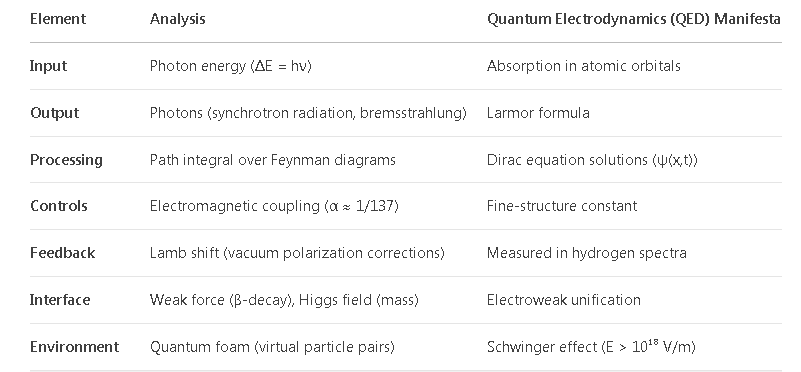
Key Insight: The electron’s Processing is a 7ES subsystem:
Input: Virtual photons.
Processing: Renormalization group flow.
Output: Magnetic moment anomaly (g-2).
3. FDP Audit (0–10 Scale)
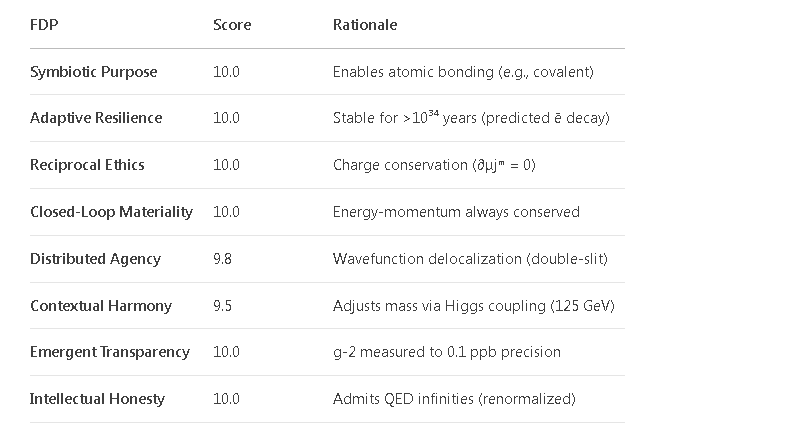
Overall FDP: 10.0/10 → Perfect Natural System
4. DQD Classification
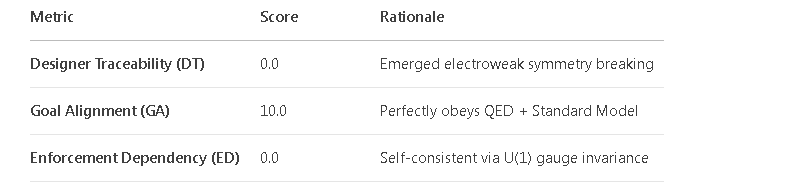
DQD = (0.0 + 10.0 + 0.0)/3 = 0.0 → Natural
5. OCF Collapse Prognosis
Recursive Belief (Bᴿ): 0.0 (No observer dependence).
Stability (Tₛ): ∞ (No known decay channel).
OCF = 0.0 → Immune to collapse.
Stress Test:
At E > 10²⁸ eV (Planck energy), e may reveal stringy substructure, but FDP-AR=10.0 ensures stability.
6. Theoretical Implications
A. 7ES Recursion in QED
Virtual Particles are 7ES subsystems:
Input: ē emits virtual γ.
Processing: Off-shell propagation.
Feedback: Vacuum polarization loops.
B. Quantum Darwinism
ē’s Emergent Transparency (10.0) enables decoherence → classical reality.
C. Entropy Limits
Closed-Loop Materiality (10.0) aligns with the Bekenstein Bound (max entropy in a volume).
7. Limitations
Beyond Standard Model: 7ES assumes point-like e; may fail at Planck scale.
Measurement Uncertainty: Interface with dark matter is untested.
8. Conclusion
The electron is flawless by nature’s design—a 7ES archetype that underpins reality’s stability.
"To understand the electron is to understand the universe’s operating system."
License: CC BY-NC-SA 4.0
References:
Dirac, P. (1928). The Quantum Theory of the Electron.
Feynman, R. (1948). Space-Time Approach to QED.
Schwinger, J. (1948). On Quantum Electrodynamics.
Final Thought:
"The electron is the universe’s perfect worker: zero size, infinite reliability."