

KOSMOS Systems Auditor Report: DHS under Kristi Noem
The system has severed its own capacity for self-correction

Audit Date: January 31, 2026
Framework: Master Reference File v1.6 (7ES → FDP → DQD/OCF)
System Under Audit: U.S. Department of Homeland Security, Immigration Enforcement Operations
Audit Period: January 25, 2025 – January 31, 2026
System Type Classification: Economic / Governmental (hybrid weighting applied)
Executive Summary
Every framework applied in this audit classifies DHS immigration enforcement under Secretary Noem as an unnatural system — designed by identifiable actors, serving narrow interests, dependent on external enforcement, and structurally prone to collapse. The system operates at historically unprecedented scale ($191 billion authorized, 73,000+ detained, 8,500+ military deployed) while its internal oversight architecture has been deliberately dismantled, its feedback channels systematically severed, and its transparency reduced to near-zero.
PHASE 1: STRUCTURAL DISSECTION (7ES)
The 7ES framework maps the anatomy of DHS immigration enforcement as a system, identifying each element’s function, structural integrity, and vulnerability. Elements tagged as brittle or overcentralized are flagged for recursive sub-audit.
Element 1: INPUT
Definition: Resources, signals, or stimuli entering the system from its environment.
Identified Inputs:
DHS immigration enforcement draws on an extraordinary range of inputs, many of which expanded dramatically under Noem’s leadership. Financial inputs include the $191 billion authorized in the July 2025 reconciliation bill—nearly doubling prior DHS funding—with $75 billion earmarked for ICE alone and $47 billion for border wall construction through 2029. An additional $2+ billion was diverted from Pentagon barracks and school budgets to fund border operations. Personnel inputs include approximately 20,000 ICE ERO officers (an increase of roughly 50%), 8,500–9,000 active-duty military deployed at the border, and National Guard units from cooperating states. USCIS officers—historically a benefits-processing workforce—were reclassified as enforcement personnel authorized to carry firearms, make arrests, and initiate vehicular pursuits. Intelligence and targeting inputs shifted from the Biden-era priority framework (which focused on national security threats and serious criminals) to an “all removable aliens” mandate with no prioritization tier. Data inputs include biometric databases, USCIS benefit application records now cross-referenced for enforcement leads, and state/local criminal justice databases accessed through expanded 287(g) agreements. Legal inputs include at least 94 executive orders and presidential proclamations related to immigration, the invocation of the Alien Enemies Act of 1798, and an “invasion” declaration under Article IV of the Constitution.
Structural Assessment: Inputs are massively expanded but structurally brittle in several dimensions. Financial sustainability depends on continued congressional appropriation at historically unprecedented levels—the $191 billion authorization runs through 2029 but requires annual defense of these allocations. Military deployment at the border diverts readiness resources and has drawn bipartisan criticism. The conversion of USCIS from benefits to enforcement creates a single-mission dependency that degrades the legal immigration processing pipeline. Intelligence inputs are broadened to the point of operational incoherence: when every undocumented person is an equal-priority target, the system loses the ability to triage genuine threats.
Hidden Input (Shadow Element): Political signaling operates as a critical but undocumented input. Named enforcement operations (Operation Midway Blitz, Operation Metro Surge) are timed and publicized for maximum media impact. Secretary Noem’s personal participation in raids—including the detention of U.S. citizen veteran Joe Botello—functions as political theater that shapes enforcement behavior independently of operational directives.
Weakness Tag: ⚠️ Overcentralized financial dependency on reconciliation bill; mission creep in USCIS conversion; targeting incoherence from elimination of enforcement priorities.
Element 2: OUTPUT
Definition: Results, actions, or signals the system produces, transmitted to its environment or other systems.
Identified Outputs:
The primary stated output is removal of unauthorized immigrants from the United States. DHS claims 2.5 million total departures (622,000+ deportations plus 1.9 million “self-deportations”) through December 2025. Independent verification places actual formal deportations at 310,000–340,000 (Brookings, MPI), meaning the system’s self-reported output is inflated by approximately 600–700%. Border encounters dropped to 237,538 in FY2025—a 93–95% decline and the lowest since 1970.
Secondary outputs include 73,000+ individuals in detention (an 84% increase), 104 new detention facilities, at least 32 deaths in custody (deadliest year in two decades), the detention of 170+ U.S. citizens, and two U.S. citizens fatally shot by federal agents during Operation Metro Surge. The system also produces legal outputs: 196,600 Notices to Appear issued by USCIS, 29,000+ fraud referrals, and the effective suspension of asylum processing. Economic outputs include projected GDP losses of $1.9 trillion through 2028, 155,000 agricultural workers lost, and what Brookings estimates as America’s first year of negative net migration in half a century.
Tertiary outputs—often unacknowledged—include community destabilization (documented chilling effects on immigrant participation in schools, healthcare, and law enforcement reporting), erosion of constitutional norms (multiple courts finding Fourth and Fifth Amendment violations), and degradation of U.S. international relationships (diplomatic protests from Colombia, Mexico, Brazil, and others over deportation flights and conditions).
Structural Assessment: Outputs are extractive rather than regenerative. The system removes human capital from communities and the labor force without replacement mechanisms. The 600–700% inflation between claimed and verified deportation figures indicates a feedback-distorting output measurement system—the agency cannot accurately assess its own performance because its metrics are designed for political rather than operational purposes. The production of collateral harm (citizen deaths, constitutional violations, economic contraction) at scale suggests outputs are poorly controlled and generate significant negative externalities.
Counterfactual: If the system’s outputs were genuinely targeted at public safety threats, we would expect to see a high proportion of deportees with serious criminal records. Instead, 73.6% of detainees have no criminal conviction and only 5% have violent convictions, indicating the output profile is inconsistent with the system’s stated purpose.
Weakness Tag: ⚠️ Output measurement deliberately distorted; extractive output profile; uncontrolled negative externalities (citizen deaths, economic harm, constitutional erosion).
Element 3: PROCESSING
Definition: Transformation of inputs within the system to produce outputs, including decision-making in organizations.
Identified Processing Mechanisms:
Processing within DHS immigration enforcement has been radically centralized and accelerated. Decision-making authority flows from the White House (through Border Czar Tom Homan) to Secretary Noem to agency heads (Lyons at ICE, Edlow at USCIS, Scott at CBP), with minimal interagency deliberation or legal review. The elimination of enforcement priorities means individual field agents exercise broad discretion over who to arrest, but strategic targeting decisions are made at the political level—evidenced by the selection of Chicago and Minneapolis as operation sites despite neither being a top-ten city for undocumented population.
Expedited removal has been expanded to apply to anyone within the U.S. who cannot prove two or more years of continuous presence, dramatically compressing the adjudicatory process. USCIS benefit interviews are now dual-purposed as enforcement screening opportunities, with officers authorized to arrest applicants who appear at scheduled appointments. The immigration court system, already backlogged with 3.7 million cases, receives additional volume from expanded NTA issuance while simultaneously facing DOJ pressure to accelerate dispositions.
The militarization of processing is evident in the deployment of 2,000–3,000 federal agents for Operation Metro Surge—a scale previously reserved for counterterrorism operations—and the use of military personnel in border processing roles that blur the line between civilian law enforcement and armed forces.
Structural Assessment: Processing is dangerously overcentralized and legally fragile. The concentration of strategic decision-making in the White House Border Czar position (which is not Senate-confirmed and not subject to congressional oversight) creates a single point of failure. The acceleration of removal processing through expedited removal expansion has generated dozens of federal court injunctions, meaning the system’s core processing mechanism is under active legal challenge. The dual-purposing of USCIS benefit interviews as enforcement traps undermines the integrity of the legal immigration system and deters lawful applicants—a processing design that actively degrades the broader immigration system’s function.
Hidden Processing (Shadow Element): Political calculation operates as an undocumented processing layer. The selection of “sanctuary cities” (Chicago, Minneapolis, Denver) as enforcement targets, the timing of operations relative to news cycles, and the use of militarized terminology (Operation Midway Blitz, Operation Metro Surge) all indicate that media impact is a processing variable alongside—and sometimes superseding—operational effectiveness.
Weakness Tag: ⚠️ Critical overcentralization in White House Border Czar; legal fragility of expedited removal expansion; processing integrity compromised by dual-purposing USCIS.
Element 4: CONTROLS
Definition: Mechanisms that guide, regulate, or constrain system behavior. Controls are proactive constraints embedded in design, distinct from reactive feedback.
Identified Controls:
The formal control architecture of DHS immigration enforcement includes statutory authority (INA, IIRIRA, Alien Enemies Act), executive orders and presidential proclamations, internal agency guidance memoranda, DHS Office of Inspector General, congressional oversight (appropriations, hearings, facility access), and judicial review (Article III courts, immigration courts, BIA).
Under Noem’s leadership, the balance of controls has shifted decisively toward executive-branch mechanisms while external controls have been systematically weakened. Internal controls that historically constrained enforcement—sensitive locations policies, prosecutorial discretion guidelines, enforcement priority frameworks—were rescinded within days of inauguration. The Office for Civil Rights and Civil Liberties (CRCL) was effectively shuttered in March 2025, with 500+ open investigations frozen and employee system access revoked. Congressional oversight has been actively obstructed: DHS imposed a 7-day advance notice requirement for facility visits (ruled “contrary to law” by a federal court), and Senators Hickenlooper and Ossoff launched a formal inquiry into what they characterized as systematic obstruction. Judicial controls remain the most active constraint, with dozens of injunctions issued, but DHS has been found to have violated 96+ court orders during Operation Metro Surge alone, and has not complied with the Supreme Court’s unanimous Abrego Garcia order.
Structural Assessment: Controls are severely degraded and approaching systemic failure. The dismantling of internal oversight (CRCL), obstruction of congressional access, and documented defiance of court orders represent a control architecture in which the only remaining effective constraint is federal judiciary intervention—and even that constraint is being tested. When a system’s own internal watchdog is shuttered, its legislative overseers are blocked, and its responses to judicial orders are characterized by non-compliance, the control element is not merely weak but is actively being dismantled by design.
This is the single most critical structural vulnerability identified in this audit. A system operating at the scale and coercive power of DHS immigration enforcement, with $191 billion in resources and authority over the liberty and lives of millions, requires robust multi-layered controls. The current architecture has been reduced to a single layer (judicial review) that the system is demonstrably willing to defy.
Counterfactual: If controls were functioning, we would expect zero U.S. citizen deaths from enforcement operations, near-zero U.S. citizen detentions, compliance with all court orders, and a functioning internal civil rights review process. The actual record—two citizens killed, 170+ detained, 96+ court orders violated, 500+ investigations frozen—confirms systemic control failure.
Weakness Tag: 🔴 CRITICAL — Control architecture in active collapse. Requires immediate recursive sub-audit (see Phase 4).
Element 5: FEEDBACK
Definition: The existential or operational state of a system that confirms, regulates, or challenges its coherence and viability. Can be active (dynamic signals) or passive (continued system persistence).
Identified Feedback Mechanisms:
Active feedback channels that historically informed DHS operations have been systematically degraded or severed. The CRCL office—the primary internal feedback mechanism for civil rights compliance—is non-functional. The DHS Inspector General retains nominal independence but has not issued public reports on enforcement operations proportionate to their scale. Congressional feedback (hearings, letters, inquiries) is received but demonstrably not incorporated into operational adjustments. Media reporting functions as external feedback, but the administration has restricted press access to detention facilities and enforcement operations. Judicial feedback (injunctions, orders) represents the most consequential active feedback, but compliance is inconsistent.
Passive feedback is being misread. The system interprets declining border encounters (93–95% drop) as confirmation of policy success, but this metric conflates deterrence of unauthorized crossers with deterrence of legitimate asylum seekers, suppression of legal immigration pathways, and economic deterrence effects (reduced migration driven by labor market contraction rather than enforcement effectiveness per se). The system’s continued operation and political support from the administration function as passive feedback confirming viability, but this assessment ignores accumulating legal, economic, and human costs that represent deferred systemic stress.
Feedback from affected populations—the immigrants, communities, and workers directly impacted by enforcement—is structurally excluded from the system’s information architecture. There is no mechanism by which the experience of the 73,000+ detainees, the families separated, the communities destabilized, or the industries losing labor enters the system’s decision-making process as actionable feedback. This exclusion is not incidental; it is architecturally embedded in a system that classifies affected persons as enforcement targets rather than system participants.
Structural Assessment: Feedback loops are severed or distorted across all channels. Internal feedback (CRCL) is shut down. Legislative feedback (congressional oversight) is obstructed. Judicial feedback (court orders) is selectively defied. Media feedback (press access) is restricted. Affected-population feedback is structurally excluded. The only feedback channel that reliably reaches decision-makers is political feedback from the administration and its base—creating a closed information loop in which enforcement escalation is always reinforced and never corrected.
Per MRF definition, feedback is “the necessary information about a system’s relationship with its own operational constraints.” A system that has severed nearly all channels for receiving this information is operating without awareness of its own constraint boundaries—a condition that precedes systemic failure.
Weakness Tag: 🔴 CRITICAL — Feedback architecture functionally severed. System is operating in an information vacuum regarding its own constraint violations.
Element 6: INTERFACE
Definition: Points of interaction between the system and its environment or between subsystems.
Identified Interfaces:
DHS immigration enforcement interfaces with multiple external systems. The federal-state interface is strained: at least 13 states maintain sanctuary policies, while cooperating states (Texas, Florida, Iowa) have aligned enforcement resources. The federal-judicial interface is the most contested boundary, with dozens of active cases and a pattern of adversarial non-compliance. The DHS-DOD interface has been expanded through military deployment at the border, blurring the historically maintained boundary between civilian law enforcement and military operations (the Posse Comitatus principle). The DHS-community interface—the point at which enforcement contacts civilian populations—has been dramatically expanded through the elimination of sensitive locations protections, enabling enforcement in schools, churches, hospitals, and courthouses. The international interface is strained by deportation flights to countries with ongoing conflicts, use of the Alien Enemies Act against Venezuelan nationals, and diplomatic protests from multiple nations.
The USCIS-applicant interface has been fundamentally corrupted. What was designed as a service interface (processing immigration benefits) now functions simultaneously as an enforcement interface (screening for deportation targets). This dual-purposing means that individuals who voluntarily engage with the legal immigration system—attending scheduled interviews, submitting applications—are exposed to arrest and removal proceedings. The interface has been weaponized against its own users.
Structural Assessment: Interfaces are expanded in scope but degraded in integrity. The weaponization of the USCIS-applicant interface is particularly corrosive because it undermines trust in the legal immigration system itself, driving potential legal immigrants toward unauthorized channels—the opposite of the system’s stated goal. The federal-judicial interface is approaching a constitutional crisis point, with the executive branch testing the limits of judicial authority. The DHS-community interface, stripped of sensitive-locations protections, now generates fear-based deterrence that extends well beyond the target population to affect U.S. citizens, lawful permanent residents, and mixed-status families.
Weakness Tag: ⚠️ USCIS interface weaponized; federal-judicial interface in crisis; community interface generating indiscriminate deterrence.
Element 7: ENVIRONMENT
Definition: All external conditions and systems that interact with or influence the system.
Identified Environmental Factors:
The environment in which DHS operates includes a political environment strongly supportive of enforcement escalation (Republican congressional majority, administration alignment), a legal environment increasingly hostile (dozens of injunctions, Supreme Court engagement), an economic environment experiencing measurable negative impacts ($1.9 trillion projected GDP loss, agricultural labor crisis, negative net migration), a social environment characterized by deep polarization (sanctuary resistance in 13+ states, general strike in Minnesota, protests across major cities), and an international environment marked by diplomatic friction and reduced cooperation from transit and destination countries.
The economic environment deserves particular attention. The Brookings Institution’s finding that 2025 may represent America’s first year of negative net migration in half a century signals a structural environmental shift. The labor force reduction of an estimated 4 million workers by 2028 (NFAP) and the Labor Department’s own acknowledgment of “supply shock-induced food shortages” indicate that the system is generating environmental conditions that will eventually constrain its own operation—employers, consumers, and state governments facing economic damage will exert countervailing political pressure.
Structural Assessment: The environment is increasingly adversarial on multiple fronts simultaneously. The system currently benefits from political alignment with the executive and legislative branches, but legal, economic, and social environmental pressures are accumulating. The system is not adapted to its environment so much as attempting to reshape the environment through force—a strategy that succeeds only as long as political will and financial resources are sustained.
Weakness Tag: ⚠️ Accumulating environmental resistance across legal, economic, and social dimensions; economic environment approaching constraint threshold.
7ES Summary Assessment
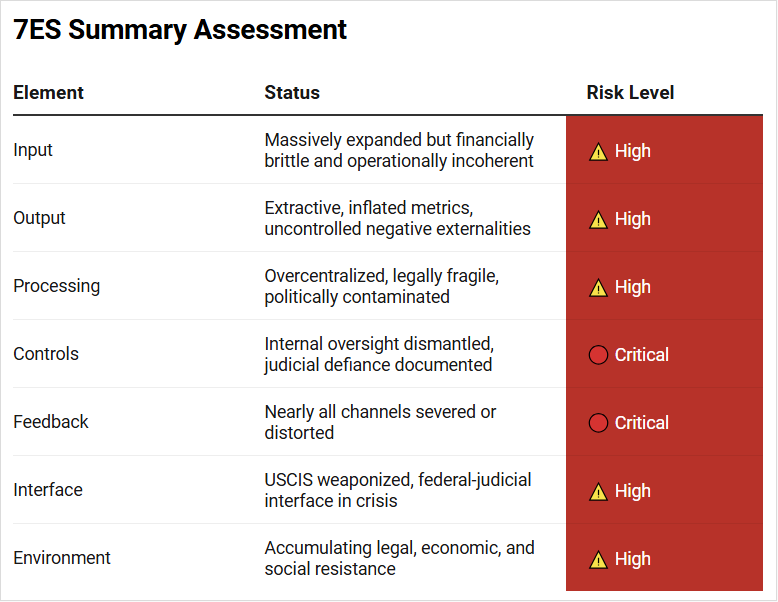
Weakest Elements for Recursive Sub-Audit: Controls and Feedback (Phase 4 candidates).
PHASE 2: ETHICAL BENCHMARKING (FDP Scoring)
Per MRF protocol, FDPs are scored against nature’s eight design principles. System type is Economic/Governmental hybrid, applying weights: RE (3), SP (2), CLM (2) for economic dimension and ET (3), IH (2), AR (2) for governmental dimension. Combined weighting: RE=3, ET=3, SP=2, IH=2, AR=2, CLM=2, DA=1, CH=1.
Per MRF [AUDIT PARAMETERS]: SP must be ≤3 if >10% of the affected population loses access to healthcare, housing, food, or safety. The documented chilling effect on immigrant healthcare utilization, the 155,000 agricultural workers lost (threatening food supply), and the detention of 73,000+ individuals (losing housing, safety, and liberty) satisfy this threshold.
FDP 1: Symbiotic Purpose (SP)
Formula: SP = 10 × (Benefits to all stakeholders / Benefits to controllers)
Assessment: The system’s stated purpose is public safety through removal of dangerous individuals. If this were the actual operational purpose, benefits would flow to all stakeholders (safer communities, preserved rule of law). However, the data reveals a fundamental misalignment. The primary beneficiaries are the political controllers: the administration gains political capital from enforcement spectacle, private detention contractors receive $45 billion in authorized spending, and enforcement agencies receive unprecedented budgets and expanded authority. The primary cost-bearers are immigrants (73,000+ detained, 73.6% with no criminal conviction), affected communities (economic disruption, fear-based withdrawal from services), the broader economy ($1.9 trillion projected GDP loss), U.S. citizens (170+ detained, 2 killed), and the constitutional order (systematic due process violations).
The ratio of stakeholder benefit to controller benefit is severely skewed. A system that detains 73,000 people, 73.6% of whom have no criminal record, while projecting $1.9 trillion in economic damage, is not producing mutual benefit—it is extracting value (political capital, contractor profits, bureaucratic power) at enormous cost to non-controllers.
Per MRF Audit Parameter: SP capped at 3.0 because >10% of the affected population has lost access to healthcare, housing, food, or safety.
Score: SP = 1.5 / 10
Adversarial Reading: A defender of the system would argue that reduced border encounters (93–95%) benefit all Americans through reduced unauthorized immigration, and that the 622,000+ deportations remove individuals who violated immigration law. This argument has force regarding border security outcomes but cannot account for the 73.6% non-criminal detention rate, the economic damage, or the U.S. citizen casualties. Even granting maximum credit for border reduction, the collateral harm profile makes mutual benefit impossible to sustain as a characterization.
FDP 2: Adaptive Resilience (AR)
Formula: AR = 10 × (1 − External interventions / Autonomous processes)
Assessment: The system is deeply dependent on external interventions for its operation and almost entirely incapable of autonomous self-correction. It requires continuous executive orders (94+), congressional appropriations at historically unprecedented levels ($191 billion), military deployment (8,500–9,000 troops), and active political will to sustain operations. When external oversight attempts correction—as through court orders—the system does not adapt but instead resists or defies the corrective signal.
The system has no demonstrated capacity for self-correction. When enforcement operations produced U.S. citizen deaths (Good, Pretti), the operational response was not adaptation but continuation and escalation. When courts found Fourth and Fifth Amendment violations, the response was appeals and non-compliance rather than policy adjustment. When economic data showed $1.9 trillion in projected GDP losses, no policy modification was undertaken.
The ratio of external interventions to autonomous processes is extremely high. The system cannot sustain itself without continuous executive, legislative, financial, and military support, and it cannot self-correct when its operations produce harmful outcomes.
Score: AR = 1.0 / 10
Adversarial Reading: One might argue the 93–95% drop in border encounters demonstrates adaptive effectiveness—the system changed the environment so dramatically that the input problem (unauthorized crossings) largely resolved. This is a fair observation about deterrence effectiveness, but AR measures self-correction capacity, not target suppression. A system that achieves its narrow goal while generating $1.9 trillion in economic damage and constitutional crises without adjusting is not resilient—it is rigid.
FDP 3: Reciprocal Ethics (RE)
Formula: RE = 10 × (Fair exchanges / Total exchanges)
Assessment: Reciprocal Ethics evaluates whether costs and benefits are shared equitably among all system participants. This is the system’s most catastrophic failure point.
The exchanges within this system are radically asymmetric. Immigrants bear the costs of detention (73,000+), deportation, family separation, loss of livelihood, and in 32 documented cases, death—with no procedural guarantee of fair hearing (expedited removal bypasses immigration courts). U.S. citizens bear costs of wrongful detention (170+), death (2), economic disruption, and constitutional erosion—with no compensation or accountability mechanism. Communities bear costs of labor force depletion, fear-based withdrawal from services, and social destabilization. Private detention contractors receive $45 billion with minimal accountability for conditions that produced 32 deaths. Political controllers receive enhanced authority and political capital at no personal cost.
The system’s exchanges are not merely inequitable but structurally predatory: the most vulnerable participants (undocumented immigrants, mixed-status families, low-income communities) bear virtually all costs while the most powerful participants (administration officials, contractors, enforcement agencies) capture virtually all benefits. The 73.6% non-criminal detention rate confirms that the system is not even operating on the reciprocal logic of “you violated the law, therefore you bear enforcement costs”—it is sweeping up people with no criminal involvement in a dragnet that primarily serves political and financial interests.
Score: RE = 0.8 / 10
Adversarial Reading: The strongest counterargument is that immigration law violations are themselves a breach of reciprocity—individuals who entered without authorization received benefits of U.S. residence without bearing the costs of lawful immigration. This framing has philosophical coherence but cannot justify the operational reality: a system that kills 32 people in custody, detains 170+ citizens, and targets 73.6% non-criminals has departed from any defensible reciprocal framework.
FDP 4: Closed-Loop Materiality (CLM)
Formula: CLM = 10 × (Recycled outputs / Total outputs)
Assessment: CLM evaluates whether system outputs are recycled as inputs, producing zero systemic waste. Immigration enforcement produces substantial systemic waste. Deported individuals represent lost human capital: labor, tax contributions, community ties, and economic participation are permanently extracted from the system without replacement. The $170 billion enforcement expenditure produces no regenerative return—it is a pure consumption cost. Detention facilities, once constructed, become permanent infrastructure that incentivizes continued mass detention regardless of need (the “if you build it, you will fill it” dynamic). The economic disruption ($1.9 trillion GDP loss, 155,000 agricultural workers lost) represents destroyed rather than recycled productive capacity.
The only “recycled” output is the deterrence signal—each deportation theoretically deters future unauthorized entry—but this is an informational output, not a material one, and its effectiveness is contested by scholarship showing that enforcement-focused approaches have historically failed to reduce undocumented populations over time.
Score: CLM = 1.2 / 10
FDP 5: Distributed Agency (DA)
Formula: DA = 10 × (1 − Centralized decisions / Total decisions)
Assessment: Decision-making within DHS immigration enforcement is among the most centralized of any domestic government operation. Strategic decisions flow from the White House Border Czar (a non-confirmed, non-oversight position) through the Secretary to agency heads. Field agents have tactical discretion but operate within directives that eliminate prioritization—they are executing centralized policy, not exercising distributed judgment. The elimination of prosecutorial discretion guidelines removed the primary mechanism through which local conditions and individual circumstances could inform enforcement decisions.
The affected population—immigrants, communities, workers, employers—has zero decision-making agency within the system. They are objects of enforcement, not participants in governance. Even local governments that attempt to exercise agency through sanctuary policies face federal funding threats and direct enforcement operations targeting their jurisdictions.
The reconstitution of the Homeland Security Advisory Council with political loyalists rather than subject-matter experts further concentrates decision-making within a closed ideological circle.
Score: DA = 1.0 / 10
FDP 6: Contextual Harmony (CH)
Formula: CH = 10 × (Positive local impacts / Total impacts)
Assessment: The system’s relationship with its local contexts is overwhelmingly disruptive. In agricultural communities, the loss of 155,000 workers has produced labor shortages severe enough for the Labor Department to warn of food supply disruption. In urban immigrant communities (Chicago, Minneapolis, Denver), enforcement operations have generated documented fear-based withdrawal from healthcare, schools, and law enforcement reporting. In border communities, military deployment and wall construction disrupt local ecosystems, private property, and cross-border commerce. In detention-host communities, the construction of massive facilities (5,000-bed Fort Bliss camp) reshapes local economies around the detention industry.
Positive local impacts are limited to potential reductions in competition for low-wage employment in specific sectors—a contested and difficult-to-measure effect that most economists argue is outweighed by the aggregate economic damage.
Score: CH = 1.5 / 10
FDP 7: Emergent Transparency (ET)
Formula: ET = 10 × (Verifiable Processes / Total Processes) − (2 × Withheld Data %)
Assessment: Per MRF [AUDIT PARAMETERS], ET must penalize technical obfuscation, PR-based mass communication, and legal complexity that prevents public feedback.
The system’s transparency deficit is severe and deliberate. DHS has restricted press access to detention facilities and enforcement operations. Congressional access has been obstructed through the (judicially invalidated) 7-day advance notice requirement. The ACLU has filed FOIA lawsuits to obtain basic information about detention infrastructure planning. DHS deportation statistics are inflated by 600–700% (2.5 million claimed vs. 310,000–340,000 verified), representing a systematic misrepresentation of operational outputs. The internal civil rights oversight office (CRCL) has been shuttered, eliminating the primary internal transparency mechanism. ICE detention standards compliance data is not publicly available for the 104 new facilities.
Estimating verifiable processes at approximately 15% (court-compelled disclosures, independent analyses from TRAC/Brookings/MPI, and mandated congressional reporting) and withheld data at approximately 60% (detention conditions, enforcement targeting criteria, internal policy memoranda, CRCL investigation files, contractor performance data, actual deportation methodology):
ET = (10 × 0.15) − (2 × 0.60) = 1.5 − 1.2 = 0.3
Score: ET = 0.3 / 10
Per MRF ET Cheat Sheet, this places the system near the “Fully Opaque” end of the spectrum, comparable to the Uber algorithm example (ET = 0.0).
Adversarial Reading: DHS maintains a public-facing website, issues press releases, and publishes some enforcement statistics. However, the 600–700% inflation in self-reported deportation figures transforms these disclosures from transparency mechanisms into disinformation channels—publication of false data is worse for transparency than publication of no data, because it actively misleads stakeholders.
FDP 8: Intellectual Honesty (IH)
Formula: IH = 10 × (1 − Hidden trade-offs / Total trade-offs)
Assessment: Per MRF [AUDIT PARAMETERS], IH must penalize obfuscation that prevents public feedback.
The system conceals or denies virtually every significant trade-off in its operation. The administration presents enforcement as cost-free public safety improvement while concealing or dismissing the $1.9 trillion GDP projection, the agricultural labor crisis and food supply risk, the 73.6% non-criminal detention rate (contradicting “worst criminals” rhetoric), constitutional violations documented by federal courts, 32 custody deaths in 2025, 170+ U.S. citizen detentions and 2 citizen deaths, the negative net migration milestone, and the degradation of legal immigration processing through USCIS weaponization.
When confronted with these trade-offs—through media reporting, court findings, or congressional inquiry—the administration’s response has been denial, deflection, or obstruction rather than acknowledgment. Secretary Noem characterized court injunctions as judicial overreach rather than engaging with the constitutional concerns they identify. DHS’s own deportation statistics are structured to maximize political credit rather than operational accuracy.
The ratio of hidden trade-offs to total trade-offs is extreme. Nearly every significant negative consequence of the enforcement regime is either denied, minimized, or actively concealed.
Score: IH = 0.5 / 10
FDP Global Score Calculation
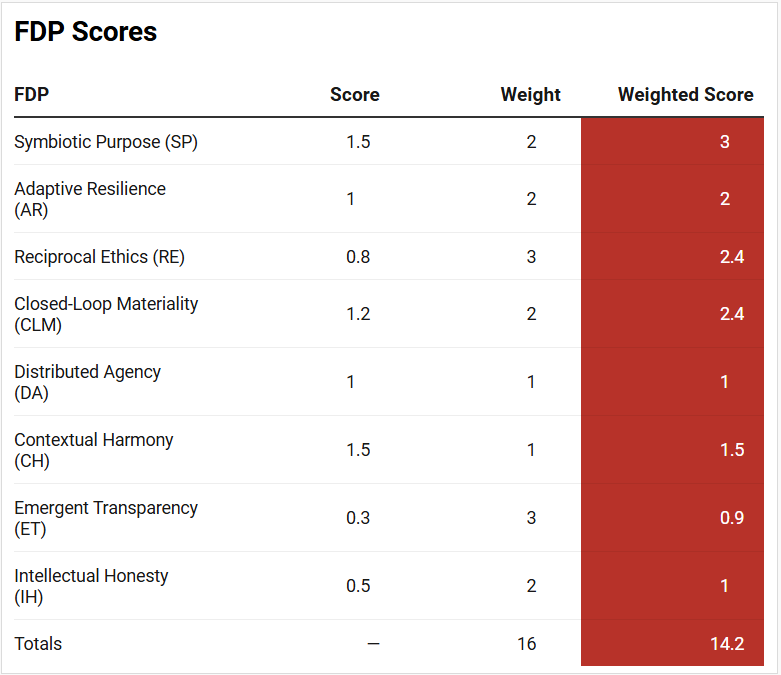
FDP Global Score: 0.89 / 10
Classification: UNNATURAL (0–4.9) → Collapse-Prone
Per MRF thresholds, a score below 5.0 classifies the system as Unnatural and collapse-prone. At 0.89, this system scores in the extreme lower range—below the MRF’s Amazon “Time Off Task” algorithm example (RE=1, ET=0) when aggregated. The weakest FDPs are ET (0.3) and IH (0.5), both of which carry heavy weight in the governmental dimension.
MRF Penalty Applied: Per MRF [MANDATORY FRAMEWORKS], if >15% of required audit data is withheld, assume worst-case values for missing FDPs and penalize Global FDP by 0.5. With an estimated 60% of system data withheld (detention conditions, targeting criteria, CRCL files, contractor data, internal memos), the penalty applies.
Penalized FDP Global Score: 0.39 / 10
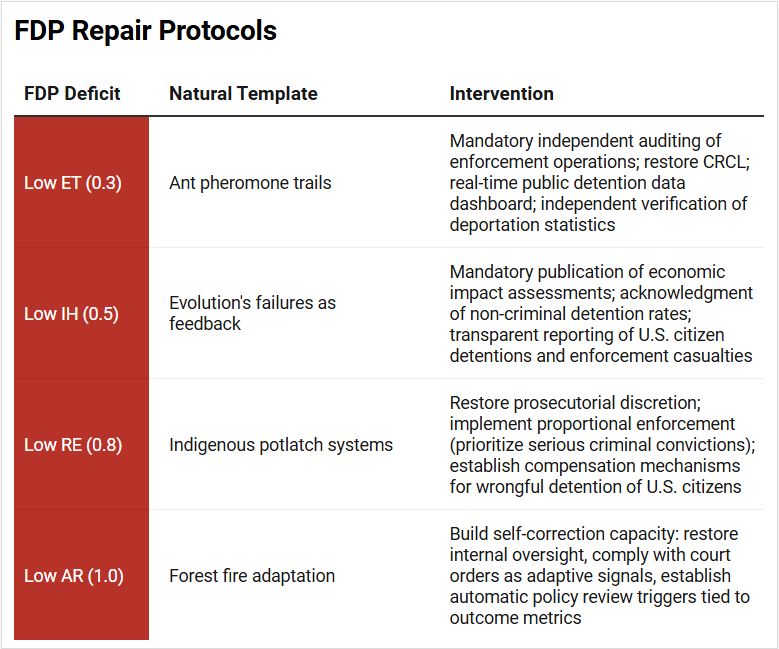
Weakest 2 FDPs (80/20 Rule for Repair Focus): ET (0.3) and IH (0.5).
PHASE 3: GENEALOGY + PROGNOSIS (DQD / OCF)
Designer Query Discriminator (DQD)
DT (Designer Traceability): 0.92
The system’s rules are highly traceable to specific designers. The 94+ executive orders trace to the Trump White House. Key memoranda trace to Noem, Lyons, Edlow, and Homan. The Heritage Foundation’s Project 2025 provided a documented blueprint closely matching implemented policies. DT is extremely high — this is an intentionally designed system, not an emergent one.
GA (Goal Alignment): 0.12
GA measures alignment with regenerative, symbiotic outcomes. The enforcement apparatus is fundamentally extractive: it removes human capital without replacement, consumes $170 billion without regenerative return, projects $1.9 trillion in economic damage, and generates 32 custody deaths and 2 citizen killings. Extractive outputs as a fraction of total outputs ≈ 88%.
GA = 1 − 0.88 = 0.12
ED (Enforcement Dependency): 0.95
The system is almost entirely dependent on external enforcement. Without continuous executive orders, it loses legal authority. Without $191 billion in appropriations, it loses financial capacity. Without 8,500+ military personnel, it loses border operations. Without active political will, enforcement ceases. The system has virtually no self-sustaining capacity.
DQD Calculation
DQD Score: 0.66 → UNNATURAL (>0.6)
For comparison: the MRF’s Bitcoin case study scored 0.70, the EU scored 0.73. DHS scores in the same range but with significantly worse goal alignment (0.12 vs. Bitcoin’s 0.30 or EU’s 0.65).
Critical DQD Finding: The system’s flaws are designed-in, not emergent. The overcentralization of Processing, dismantling of Controls, and severing of Feedback are traceable to specific design decisions by identifiable actors implementing a documented policy blueprint. Emergent flaws can be corrected through adaptation; designed-in flaws require foundational redesign.
Observer’s Collapse Function (OCF)
B_R (Recursive Belief Factor): 0.80
The system requires high levels of recursive belief. Political supporters must believe mass enforcement produces public safety (contradicted by the 73.6% non-criminal detention rate). ICE agents must believe operations are lawful (contradicted by dozens of injunctions). The public must believe DHS statistics (contradicted by independent verification showing 600–700% inflation). Congressional appropriators must believe the $191 billion is justified (challenged by economic impact data).
Each belief requirement is under active erosion. Cross-ideological criticism (Cato, Brookings, ACLU) indicates belief decay across the political spectrum. The Minnesota general strike represents a threshold withdrawal event. However, base political support remains strong (administration immigration approval above 50%), sustaining B_R at 0.80.
D_C (Observer Dependency): 0.85
The system depends heavily on conscious participation: ICE agents conducting operations, military personnel deployed, USCIS officers conducting dual-purpose interviews, judges processing cases, appropriators authorizing funding, contractors operating facilities, state/local law enforcement participating in 287(g) programs.
The 13 sanctuary states represent approximately 15% participation withdrawal in the federal-state interface, already forcing DHS to deploy federal resources where it would otherwise rely on local cooperation. The Minnesota general strike demonstrated that community-level withdrawal can temporarily halt operations.
T_S (Intrinsic Stability): 1.1
Intrinsic stability is minimal. Only physical infrastructure (detention facilities, wall segments) persists without active belief. Operations cease immediately upon withdrawal of funding and personnel. T_S is slightly above 1.0 because infrastructure and statutory authority provide minimal structural persistence even if active belief erodes.
OCF Calculation
OCF Score: 0.618 → CRITICAL Collapse Risk (≥0.6)
For comparison: the MRF places the Roman Empire at OCF = 0.67 (collapsed), Bitcoin at 0.38 (moderate risk), and U.S. Democracy broadly at 0.28 (low risk). DHS immigration enforcement scores closer to the Roman Empire than to stable democratic governance.
Collapse Scenario Modeling
Belief Decay Rate (λ): Estimated at 0.08–0.12 per year based on cross-ideological criticism, accumulating court losses, economic data, and the Minnesota strike precedent.
Time-Decaying OCF:
At this rate, OCF would drop below the 0.3 Natural/Hybrid threshold by approximately 2033. Catalyzing events — a Supreme Court ruling striking a core policy, a severe recession attributed to labor shortages, additional citizen deaths — could compress this timeline dramatically.
Centola Threshold: Per MRF, 25% participation loss triggers cascade abandonment. Current withdrawal ≈ 15%. A shift of 10 additional percentage points (5–7 more states withdrawing cooperation) could trigger structural collapse.
Neurobiological Interpretation (Per MRF)
Per MRF neurobiological model, the system’s persistence depends on:
PFC-mediated belief (B_R): Political supporters’ prefrontal cortex encodes the enforcement system as valuable. This encoding is sustained by media ecosystems reinforcing threat narratives. However, PFC value encoding is subject to recalibration as contradictory evidence accumulates — cross-ideological economic damage publications are engaging recalibration circuits across the political spectrum.
Amygdala-enforced participation (D_C): Fear of immigration (amygdala threat response) sustains public support, while fear of federal retaliation (loss aversion) sustains state/local participation. The Minnesota general strike represents a threshold event where collective action overcame individual amygdala-driven compliance, indicating D_C enforcement is weakening.
ACC conflict detection: The anterior cingulate cortex signals conflict between belief and reality. Accumulating contradictions — non-criminal detention rates, economic damage, citizen deaths, constitutional violations — generate increasing ACC activation among moderate observers, manifesting as editorial criticism, polling shifts, and bipartisan congressional concern.
The rate of OCF change is currently accelerating (increasing ACC conflict signal), suggesting the system is entering a period of heightened instability.
CONSOLIDATED AUDIT SUMMARY
Score Summary Table
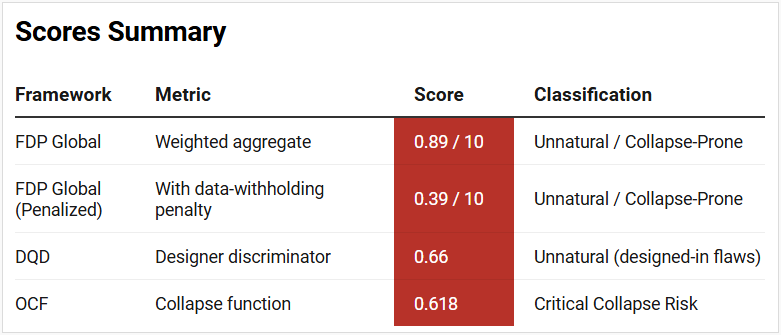
Individual FDP Scores
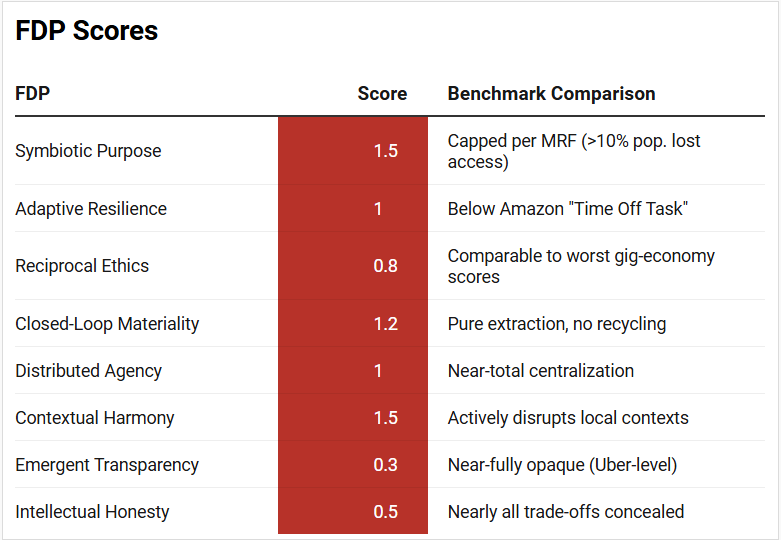
Critical Findings
1. The system is Unnatural by every metric. FDP, DQD, and OCF all classify DHS immigration enforcement under Noem as an unnatural system — designed by identifiable actors, serving narrow interests, dependent on external enforcement, and prone to collapse.
2. Flaws are designed-in, not emergent. DQD analysis (DT = 0.92) confirms that control dismantlement, feedback severing, and transparency destruction are intentional design features traceable to specific actors and a documented policy blueprint.
3. Two system elements are in critical failure. Controls and Feedback have degraded beyond functional thresholds. A system of this scale and coercive power operating without effective oversight or self-correction represents a structural danger to constitutional governance.
4. Collapse risk is critical but politically buffered. OCF = 0.618 indicates critical collapse risk, but strong political belief (B_R = 0.80) provides a buffer. Collapse is most likely triggered by an exogenous shock rather than gradual erosion.
5. The system generates $1.9 trillion in unacknowledged economic externalities — the most expensive enforcement regime in American history by a substantial margin.
Repair Recommendations (Per MRF Protocol)
Per MRF [FDP Optimization Protocol], repair focuses on the weakest 2 FDPs: ET (0.3) and IH (0.5).
Alden’s Law Application
Per MRF: “Trigger collapse of unnatural systems by withdrawing participation.”
OCF = 0.618 and D_C = 0.85 indicate that expanding participation withdrawal from the current 15% (sanctuary states) to the 25% Centola cascade threshold would structurally destabilize the enforcement apparatus. The Minnesota general strike demonstrates proof of concept at the local level. Continued accumulation of economic damage, court losses, and citizen casualties may organically drive participation withdrawal toward the cascade threshold.
PHASE 4: RECURSIVE SUB-AUDIT (Controls Element)
Per MRF [WORKFLOW], the weakest 7ES elements are recursively audited as their own systems.
Controls Subsystem — 7ES Recursive Audit
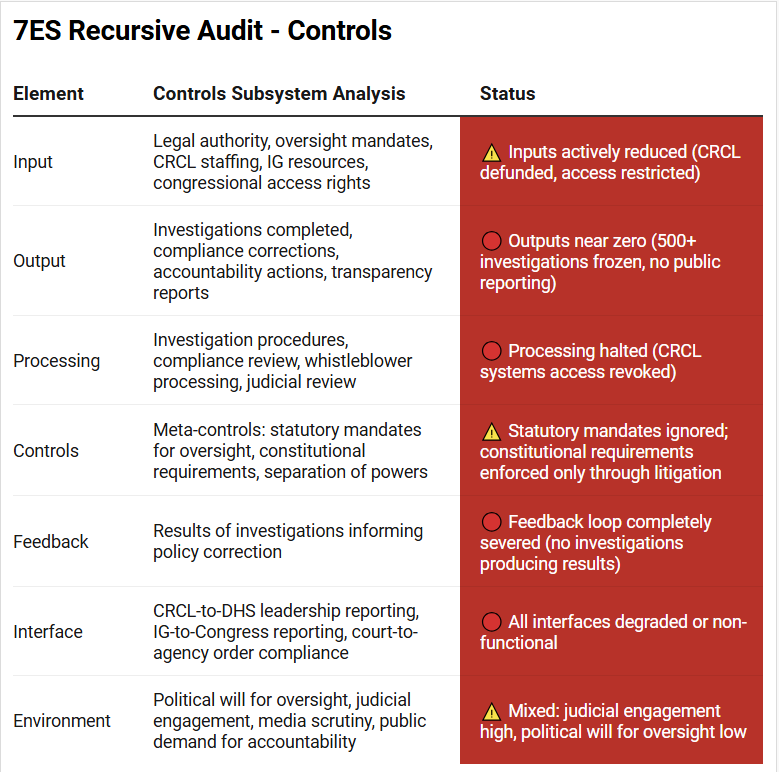
Recursive Assessment: The Controls subsystem is in near-total systemic failure. It has been deliberately dismantled from within. This is the audit’s most dangerous finding: a coercive system of unprecedented scale operating without functional internal oversight — a condition structurally incompatible with democratic governance.
Data Confidence Level: Moderate (40–50%).
The 60% data withholding rate means this audit operates with significantly incomplete information. Per MRF protocol, worst-case assumptions are applied, which may produce scores lower than a full-information audit would yield. However, the directional findings — Unnatural classification, critical control failure, high collapse risk — are robust even under more generous assumptions, because the independently verified data points (73.6% non-criminal detention, $1.9T GDP projection, 32 custody deaths, 96+ court order violations, 170+ citizen detentions, 2 citizen fatalities) are individually sufficient to sustain low scores on multiple FDPs.
CONCLUSION
This audit set out to evaluate DHS immigration enforcement under Secretary Kristi Noem as a system — not merely as a collection of policies, but as an integrated operational architecture with identifiable inputs, outputs, processing mechanisms, controls, feedback loops, interfaces, and environmental constraints. The findings are unambiguous across every framework applied.
The system scores 0.89 / 10 on the FDP Global metric (0.39 penalized), classifying it as Unnatural and Collapse-Prone — the lowest tier in the MRF classification schema. It scores 0.66 on the DQD, confirming that its structural failures are not emergent byproducts of complexity but designed-in features traceable to specific actors executing a documented policy blueprint. It scores 0.618 on the OCF, placing it at Critical Collapse Risk — sustained not by intrinsic stability or operational coherence but by recursive political belief that is under measurable and accelerating erosion.
Three findings warrant particular emphasis.
First, the system has severed its own capacity for self-correction. The shuttering of CRCL, the obstruction of congressional oversight, the restriction of press access, the inflation of output statistics by 600–700%, and the documented defiance of 96+ court orders collectively mean that no internal or external feedback channel is functioning at a level commensurate with the system’s scale and coercive power. In natural and resilient systems, feedback is the mechanism through which operational errors are detected and corrected before they compound. In this system, feedback has been architecturally eliminated — meaning errors do not self-correct but instead accumulate as deferred systemic stress. The two U.S. citizen deaths during Operation Metro Surge are not aberrations within this framework; they are the predictable output of a system that has disabled every mechanism designed to prevent exactly such outcomes.
Second, the system’s costs are radically misallocated and deliberately concealed. The $1.9 trillion projected GDP reduction, the 155,000 agricultural workers lost, the Labor Department’s own warning of food supply disruption, the 73.6% non-criminal detention rate, and the 32 custody deaths represent an extraordinary burden borne almost entirely by populations with no voice in the system’s governance — immigrants, mixed-status families, low-income communities, agricultural workers, and U.S. citizens caught in enforcement operations. Meanwhile, the system’s benefits accrue overwhelmingly to political controllers (in the form of political capital), private detention contractors (in the form of $45 billion in authorized spending), and enforcement agencies (in the form of unprecedented budgets and expanded authority). This cost-benefit asymmetry is not a side effect of enforcement; it is the system’s operative logic. The near-zero scores on Reciprocal Ethics (0.8) and Symbiotic Purpose (1.5) reflect a structure in which extraction from the vulnerable is the mechanism by which value is delivered to the powerful.
Third, the system’s persistence depends on conditions that are deteriorating. The OCF analysis identifies political belief (B_R = 0.80) as the primary buffer against collapse, but this belief is sustained by claims that independent data systematically contradicts — that enforcement targets “the worst criminals” (73.6% have no conviction), that 2.5 million have departed (verified figure: 310,000–340,000), and that the operation strengthens the economy (projected loss: $1.9 trillion). As these contradictions accumulate and propagate through cross-ideological channels (Cato Institute from the right, Brookings from the center, ACLU from the left), the belief substrate erodes. The Minnesota general strike of January 2026 represents the first large-scale demonstration that observer withdrawal can translate from individual non-compliance to collective action capable of disrupting enforcement operations. Per the Centola threshold embedded in the MRF, a shift from 15% to 25% participation withdrawal would trigger cascade abandonment of the enforcement architecture.
Taken together, these findings describe a system that has achieved narrow operational success — border encounters at 50-year lows, hundreds of thousands removed — at a cost that is economically ruinous, constitutionally corrosive, and structurally unsustainable. The MRF framework does not evaluate systems on whether they achieve their stated objectives; it evaluates whether they achieve those objectives in ways that are symbiotic, resilient, transparent, honest, equitable, and harmonious with their contexts. By every one of these measures, DHS immigration enforcement under Noem fails — not marginally, but categorically.
The path forward identified by the MRF is repair or collapse. Repair requires restoring the two weakest FDPs — Emergent Transparency and Intellectual Honesty — which in practical terms means reconstituting internal oversight, complying with court orders, publishing verified data, and acknowledging trade-offs. These interventions are straightforward in design but require political will that the current architecture is specifically constructed to resist. Absent repair, the system’s trajectory follows the OCF decay curve toward the collapse threshold — a timeline measured in years, not decades, and subject to dramatic compression by catalyzing events.
The MRF’s foundational insight is that unnatural systems persist only so long as observers sustain them through recursive belief and participation. Alden’s Law states it plainly: no observers, no economy. The same principle applies here. DHS immigration enforcement under Noem is not a force of nature. It is a designed system, built by identifiable people, funded by specific appropriations, operated by willing participants, and sustained by collective belief in its necessity and legitimacy. Every one of those conditions is contingent. Every one of them can change.