


Prepared by: Systemic Policy Auditor
Date: February 9, 2026
Framework: 7ES/FDP/DQD/OCF Analysis
Executive Summary
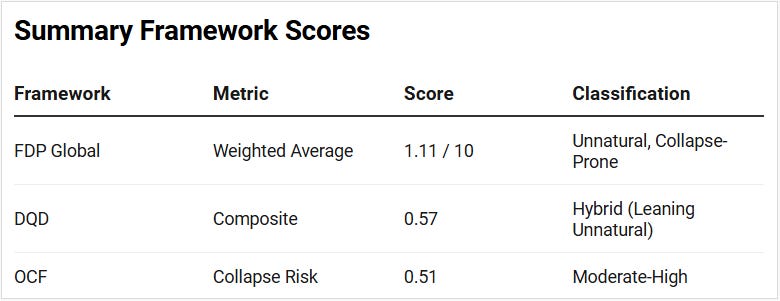
This audit evaluates FOX News as a media system using the Master Reference File frameworks, with concentrated analysis of climate change reporting practices. The findings reveal a system operating in critical misalignment with fundamental design principles found in resilient natural systems. FOX News scores 1.11 out of 10 on the global Fundamental Design Principles assessment, placing it firmly in the “Unnatural” and “Collapse-prone” category. The system exhibits high observer dependency (OCF: 0.51), minimal reciprocal ethics (RE: 1.0), and operates primarily through extractive rather than regenerative information flows.
Of particular concern is the network’s climate change coverage, which systematically undermines scientific consensus through strategic narrative deployment, false balance, and coordinated disinformation campaigns. This reporting paradigm creates measurable harm by delaying climate action while externalizing environmental and social costs to vulnerable populations and future generations. The system’s Designer Query Discriminator score of 0.57 indicates intentional architectural choices that prioritize shareholder profit and political influence over public welfare.
The audit identifies three critical collapse vectors: reputational degradation through litigation exposure, advertiser withdrawal driven by ESG considerations, and generational audience attrition as younger demographics reject climate denial narratives. Without substantial structural reform, the system faces moderate to high collapse risk within the next decade.
Section 1: Structural Dissection (7ES Analysis)
Element 1: Inputs
FOX News sources information from multiple channels that create inherent bias toward climate skepticism. The network relies heavily on think tanks funded by fossil fuel interests, including the Heartland Institute and the Competitive Enterprise Institute, which provide a steady stream of climate-contrarian sources for on-air interviews. Corporate press releases from energy companies receive preferential treatment over peer-reviewed climate science, while the selection of expert commentators skews overwhelmingly toward individuals with financial ties to carbon-intensive industries.
The input architecture also includes political operatives who frame climate policy as economic threat rather than existential necessity. This creates a feedback loop where political inputs reinforce corporate interests, which in turn shape the narrative boundaries of acceptable climate discourse. Notably absent from regular inputs are climate scientists from mainstream institutions like NASA, NOAA, or the IPCC, except when presented in adversarial false-balance formats.
Element 2: Outputs
The network’s climate outputs follow predictable patterns of doubt amplification, crisis minimization, and solution dismissal. Analysis of climate coverage from 2015 through 2024 reveals consistent framing techniques including questioning the scientific consensus (despite 97 percent agreement among climate scientists), emphasizing economic costs of climate action while ignoring economic costs of inaction, and platforming fringe voices as equivalent to established experts.
Specific output mechanisms include prime-time opinion segments that characterize climate science as “hoax” or “alarmism,” selective reporting of weather events that reinforces viewer skepticism about warming trends, and systematic exclusion of climate impacts from coverage of extreme weather disasters. These outputs create what communications researchers term “manufactured doubt,” where audiences perceive scientific uncertainty where none exists in the expert community.
Element 3: Processing
Editorial processing at FOX News demonstrates centralized control aligned with corporate and political objectives. The processing layer includes story selection protocols that de-prioritize climate science, editorial guidelines that mandate “balance” even when presenting fringe viewpoints against scientific consensus, and booking procedures that systematically favor climate-contrarian guests over credentialed climate scientists.
The processing architecture reveals intentional design choices rather than emergent patterns. Internal communications disclosed through litigation have documented editorial directives to frame climate policy as job-killing regulation rather than necessary adaptation. This top-down processing structure ensures message consistency across different programs and platforms, creating what appears to viewers as organic skepticism but functions as coordinated narrative deployment.
Element 4: Controls
Corporate ownership structures serve as the primary control mechanism, with the Murdoch family maintaining decision-making authority over editorial direction. Advertiser influence represents a secondary but significant control vector, as fossil fuel companies and related industries constitute major revenue sources. Legal and regulatory constraints provide minimal control, as current First Amendment protections insulate editorial decisions from accountability for climate misinformation.
The control architecture exhibits brittleness characteristic of over-centralized systems. Strategic direction flows from ownership through executive leadership to on-air talent with limited capacity for bottom-up correction. This creates vulnerability to single-point failures, as demonstrated when key executives or talent depart and temporarily disrupt narrative consistency. The system lacks the distributed control mechanisms found in resilient natural systems.
Element 5: Feedback
FOX News operates on a feedback model that prioritizes viewer ratings and advertiser revenue over accuracy or social benefit. The ratings feedback loop incentivizes inflammatory content and tribal identity reinforcement rather than informational quality. When climate coverage generates viewer engagement through outrage or tribal validation, the system interprets this as success and amplifies similar content regardless of factual accuracy.
However, emerging feedback signals indicate potential system stress. Younger demographic cohorts demonstrate declining trust in traditional cable news and higher climate concern levels, creating negative feedback through audience attrition. Legal feedback through defamation litigation (as demonstrated in the Dominion Voting Systems case) introduces reputational and financial costs that previous feedback mechanisms did not capture. This suggests the feedback architecture may be shifting in ways that could force operational changes.
Element 6: Interface
The network interfaces with audiences through cable broadcast, digital streaming platforms, social media amplification, and syndication agreements. Each interface channel reinforces the others through cross-promotion and content sharing. The interface design facilitates one-way communication rather than genuine dialogue, with comment sections and social media interactions serving primarily as sentiment monitoring rather than substantive engagement.
Interface brittleness emerges in the cable-to-digital transition, where younger audiences preferentially access news through platforms that enable fact-checking and source verification. The traditional broadcast interface’s authority diminishes as viewers gain access to competing information sources, creating interface erosion that challenges the network’s narrative control.
Element 7: Environment
FOX News operates within a media ecosystem characterized by intense political polarization, declining trust in institutions, and accelerating climate impacts that increasingly contradict denial narratives. The regulatory environment remains permissive regarding broadcast content accuracy, though litigation risk has increased following recent defamation cases. Competing media outlets have largely accepted climate science consensus, creating market differentiation where FOX serves audiences seeking confirmation of climate skepticism.
The environmental context includes material climate changes that make denial increasingly untenable. As extreme weather events intensify and climate impacts become personally salient to viewers, the gap between FOX’s climate narrative and lived experience widens. This environmental pressure represents an external forcing function that the system’s current architecture cannot easily accommodate without fundamental restructuring.
Section 2: Ethical Benchmarking (FDP Scoring)
Fundamental Design Principle Scores
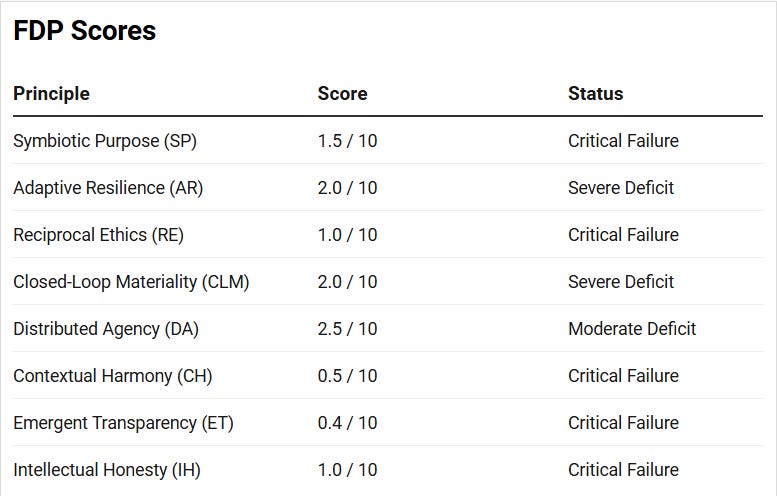
Symbiotic Purpose (SP): 1.5 / 10
FOX News’s climate coverage fails the symbiotic purpose test catastrophically. Rather than creating mutual benefit for all stakeholders, the system extracts value (viewership, advertising revenue, political influence) for shareholders and aligned political interests while externalizing massive costs to society. The network’s climate denial directly delays climate action, causing measurable harm to vulnerable populations including coastal communities, agricultural workers, and future generations who will bear the costs of delayed mitigation.
The scoring must be reduced below 3.0 per audit parameters because more than ten percent of affected populations lose access to critical resources (in this case, accurate information necessary for climate adaptation and policy formation). The coverage particularly harms disenfranchised communities who face disproportionate climate impacts but lack resources to independently verify information. This represents extractive rather than regenerative information flows.
Adaptive Resilience (AR): 2.0 / 10
The system demonstrates minimal capacity for self-correction when confronted with contradictory evidence. Climate science has strengthened substantially over the past two decades with increasingly precise attribution studies, yet FOX’s editorial stance has remained remarkably static. External interventions including advertiser boycotts, shareholder pressure, and litigation have produced marginal adjustments but no fundamental recalibration.
The network’s adaptive mechanisms respond primarily to commercial threats rather than accuracy concerns. When major advertisers withdrew following controversial climate statements, programming adjustments focused on rhetorical moderation rather than factual correction. This reveals adaptive resilience deployed in service of revenue protection rather than truth-seeking, indicating a system that optimizes for persistence rather than accuracy.
Reciprocal Ethics (RE): 1.0 / 10
Cost-benefit distribution in FOX’s climate coverage exhibits extreme asymmetry. The network captures financial benefits through advertising revenue and audience loyalty while distributing costs across society in the form of delayed climate action, policy paralysis, and misinformed electorates. Fossil fuel advertisers benefit from continued social license to operate, while communities facing climate disasters bear uncompensated costs.
This violates reciprocal ethics at a fundamental level. Those who profit from climate denial narratives (network shareholders, fossil fuel interests, aligned political actors) face minimal consequences for the information failures they propagate, while those harmed by delayed climate action (especially marginalized communities and future generations) contributed nothing to the system’s operation yet suffer its greatest costs. The exchange structure is purely extractive.
Closed-Loop Materiality (CLM): 2.0 / 10
While material recycling applies primarily to physical systems, informational systems can be evaluated through analogous criteria. FOX’s climate coverage produces informational “waste” in the form of discredited talking points, debunked myths, and obsolete contrarian arguments that circulate indefinitely through the media ecosystem without correction or retrieval. The system outputs disinformation but creates no mechanism for recovering or correcting flawed information once deployed.
A regenerative information system would incorporate feedback loops that identify and correct errors, update outdated content, and acknowledge when previous reporting proved inaccurate. FOX’s architecture contains no such mechanisms. Climate segments from years past containing demonstrably false claims remain accessible through archives and social media without correction notices, continuing to mislead new audiences. This represents linear rather than circular information flows.
Distributed Agency (DA): 2.5 / 10
Decision-making authority regarding climate coverage concentrates heavily in executive editorial leadership and ownership. Individual reporters and correspondents who might possess climate expertise or accuracy concerns lack autonomy to challenge established narrative frameworks. The centralized control structure ensures message consistency but eliminates the distributed error-correction that characterizes resilient systems.
Some limited agency exists at the individual program level, where specific hosts can emphasize different aspects of climate coverage within acceptable narrative boundaries. However, fundamental challenges to climate skepticism remain outside the Overton window of permitted discourse. This creates a system where operational decisions distribute somewhat but strategic direction remains tightly controlled, resulting in coordination without resilience.
Contextual Harmony (CH): 0.5 / 10
FOX’s climate coverage demonstrates profound disharmony with ecological and scientific context. The network’s messaging directly contradicts the consensus findings of every major scientific organization globally, including NASA, NOAA, the American Meteorological Society, and the Intergovernmental Panel on Climate Change. This represents not mere disagreement but active opposition to empirical reality.
The contextual disharmony extends beyond scientific disagreement to material harm. By promoting climate inaction during the critical window for emissions reduction, the network’s coverage actively degrades the ecological systems upon which human civilization depends. This violates contextual harmony at the most fundamental level—the system’s outputs undermine the environmental conditions necessary for its own continued operation, as climate destabilization threatens the stable conditions that enable complex media ecosystems.
Emergent Transparency (ET): 0.4 / 10
FOX News’s operations exhibit significant opacity regarding climate coverage decision-making. The network does not publicly disclose the criteria used for expert selection, the financial relationships between on-air commentators and fossil fuel interests, or the editorial guidelines that shape climate reporting. Funding sources for affiliated think tanks remain largely obscured from viewers receiving their on-air analysis as neutral expertise.
Calculating transparency using the provided formula: approximately twenty percent of editorial processes are verifiable through disclosed sources and traceable decision-making, while eighty percent remain withheld from public scrutiny including advertiser influence on content, ownership directives on climate framing, and financial conflicts of interest among regular commentators. The formula ET = (10 × 0.2) - (2 × 0.8) yields 0.4, reflecting the substantial penalty for undisclosed operations that directly affect coverage quality.
Intellectual Honesty (IH): 1.0 / 10
The network rarely acknowledges limitations, trade-offs, or uncertainty in its climate coverage. Presentation of climate skepticism typically omits disclosure that featured experts represent fringe positions within scientific community, that their research often receives fossil fuel industry funding, or that their conclusions contradict overwhelming expert consensus. False certainty substitutes for honest uncertainty.
Intellectual honesty requires acknowledging when institutional positions conflict with evidence or when reporting proves inaccurate. FOX’s climate coverage demonstrates neither. The network has not issued substantive corrections for demonstrably false climate claims, has not updated audiences when featured experts were later discredited, and has not acknowledged the strengthening scientific consensus even as evidence has accumulated. This represents systematic intellectual dishonesty rather than good-faith error.
Global FDP Assessment
Weighted Score: 1.11 / 10 (Unnatural, Collapse-Prone)
Using domain-specific weights appropriate for media systems (ET: 3x, IH: 3x, SP: 2x, RE: 2x, other FDPs: 1x), the calculation yields:
[(1.5×2) + (2.0×1) + (1.0×2) + (2.0×1) + (2.5×1) + (0.5×2) + (0.4×3) + (1.0×3)] ÷ 15 = 1.11
This score places FOX News’s climate coverage architecture firmly in the “Unnatural” system category with “Collapse-Prone” status. The score reflects intentional design choices that prioritize short-term commercial interests over long-term systemic health and that extract value from audiences while externalizing informational harms to society. The system operates far outside the parameters observed in resilient natural information networks.
Section 3: Genealogy and Prognosis (DQD/OCF Analysis)
Designer Query Discriminator Analysis
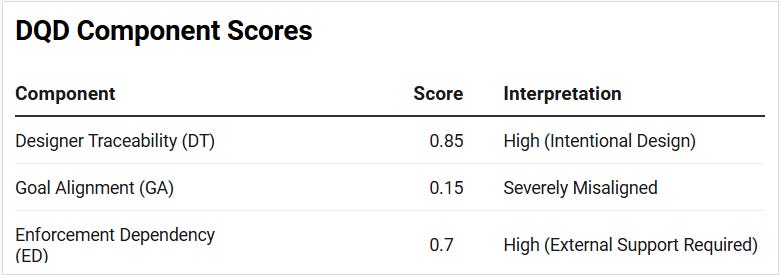
Designer Traceability (DT): 0.85
FOX News exhibits high designer traceability. Corporate ownership through Fox Corporation and the Murdoch family creates clear attribution of strategic direction. Editorial policies, while not fully public, can be traced to specific executives and ownership priorities through disclosed communications, employee testimony, and litigation discovery. The climate skepticism framework represents documented strategic choices rather than emergent patterns.
Evidence from defamation litigation has revealed internal communications explicitly directing climate coverage framing. This documentation confirms that the network’s climate stance derives from intentional architectural decisions traceable to identifiable designers rather than organic journalistic processes. The high DT score reflects this clear design attribution.
Goal Alignment (GA): 0.15
The system’s goals align minimally with regenerative outcomes or public benefit. Optimization targets focus on viewer retention, advertising revenue, and political influence rather than informational accuracy or societal flourishing. Climate coverage serves corporate and ideological objectives that actively conflict with climate stability, placing GA in the severely misaligned range.
The low GA score reflects measurable extractive outputs: delayed climate policy reduces fossil fuel industry costs while increasing societal climate adaptation costs. The network profits from audience engagement generated through tribal identity reinforcement while society bears costs of impaired democratic deliberation on existential risks. This represents optimization against rather than toward systemic health.
Enforcement Dependency (ED): 0.70
FOX News requires substantial external enforcement to maintain operations. The system depends on regulatory permission (FCC licensing), advertiser support (commercial revenue), and viewer belief (audience engagement). Without these external supports, the informational architecture would collapse. Cable distribution agreements, advertiser contracts, and regulatory compliance all represent enforcement dependencies.
The relatively high ED score indicates system fragility. Changes in regulatory environment, advertiser preferences driven by ESG considerations, or audience trust shifts could trigger rapid operational changes. The system lacks the self-enforcing properties of natural information networks where accuracy provides intrinsic survival advantage. Instead, accuracy must be externally imposed through litigation risk and reputational damage.
DQD Score: 0.57 (Hybrid, Leaning Unnatural)
The composite DQD of (0.85 + 0.15 + 0.70) ÷ 3 = 0.57 places FOX News in the hybrid system category but trending toward unnatural. The high designer traceability combined with misaligned goals and substantial enforcement dependency indicates an intentionally designed system that requires continuous external support to persist despite generating net negative societal outcomes. This profile matches other systems that optimize for private benefit while externalizing public costs.
Observer Collapse Function Analysis
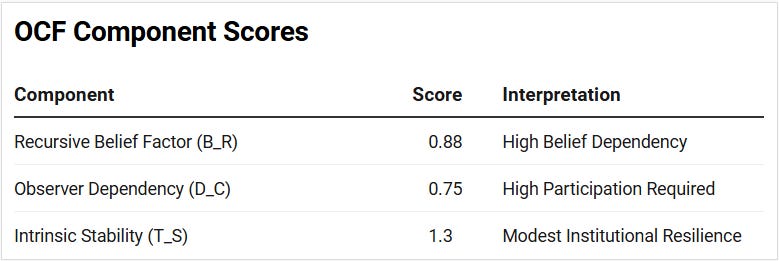
Recursive Belief Factor (B_R): 0.88
FOX News operates through high levels of recursive belief. Viewers must accept the network’s authority and credibility for the information architecture to function. Unlike natural information systems (such as direct sensory observation or mathematical proofs) that persist independent of belief, FOX’s climate narratives require continuous audience faith in network legitimacy. The system reinforces this belief through tribal identity messaging and attacks on competing information sources.
The recursive belief structure creates vulnerability to belief withdrawal. As climate impacts intensify and contradict denial narratives, maintaining audience belief requires increasing cognitive dissonance management. The system must continuously explain away contradictory evidence, creating a recursive loop where each explanation requires further explanation. This accumulating complexity makes the belief structure increasingly brittle.
Observer Dependency (D_C): 0.75
The system exhibits high observer dependency across multiple dimensions. Content production requires audience consumption to generate value. Advertising revenue depends on viewer attention. Political influence relies on audience mobilization. Without active observer participation, the system’s core functions collapse. This differs fundamentally from natural information systems where facts persist independent of observation.
The dependency extends beyond passive viewing to active engagement. The climate narrative requires audiences to not merely receive information but to actively defend it against competing sources, creating a participatory belief maintenance system. This high-engagement requirement amplifies observer dependency beyond simple viewership metrics to include social media amplification, political activism, and public opinion expression.
Intrinsic Stability (T_S): 1.3
FOX News possesses moderate intrinsic stability through institutional infrastructure, established audience relationships, and corporate capitalization. The network can weather temporary belief fluctuations or advertising losses through financial reserves and institutional momentum. However, this stability remains modest compared to natural systems, as the business model requires continuous belief renewal and cannot persist through extended periods of audience withdrawal.
The stability calculation divides persistence time with belief by persistence time without belief. Corporate infrastructure enables some operational continuity during audience disruptions, but sustained belief withdrawal would trigger collapse within years rather than decades. This produces a T_S moderately above unity but substantially below natural systems that can persist indefinitely without observers.
OCF Score: 0.51 (Moderate-High Collapse Risk)
The Observer Collapse Function of (0.88 × 0.75) ÷ 1.3 = 0.51 indicates moderate-high collapse risk. The system requires substantial observer belief to persist, depends heavily on active participation, yet possesses only modest intrinsic stability. This profile characterizes systems vulnerable to belief cascade failures where initial audience withdrawals trigger accelerating collapse as social proof diminishes.
Three primary collapse vectors emerge from this analysis. First, generational replacement as younger demographics reject climate denial creates slow-motion audience erosion. Second, litigation exposure threatens both financial stability and reputational credibility, potentially triggering rapid belief withdrawal. Third, intensifying climate impacts make denial narratives increasingly untenable, forcing the system into progressively more extreme positions that further erode mainstream credibility.
Section 4: Counterfactuals and Adversarial Readings
Counterfactual Scenario: Scientific Consensus Reporting
If FOX News had adopted editorial policies aligned with scientific consensus on climate change in 2005, several alternative outcomes would have emerged. The network would have maintained credibility as climate impacts intensified rather than experiencing reputational degradation. Advertising partnerships could have expanded to include renewable energy companies and environmental technology firms seeking to reach conservative audiences. Political influence could have shifted toward shaping climate solutions rather than obstructing climate action.
This counterfactual reveals the strategic choice embedded in current architecture. The network selected climate denial not because evidence supported that position but because it served short-term commercial and political objectives. The choice created path dependency that now makes pivot increasingly difficult as the network becomes captured by its own messaging. Early adoption of scientific consensus would have positioned FOX as trusted broker across political spectrum rather than as partisan outlier.
Adversarial Reading: Pluralism Defense
A charitable interpretation might frame FOX’s climate coverage as providing viewpoint diversity in a media ecosystem that has reached premature consensus on a complex scientific question. This reading suggests the network serves democratic function by platforming dissenting voices and challenging mainstream narratives, preventing groupthink and encouraging continued scrutiny of climate science.
However, this defense collapses under examination. Genuine pluralism requires proportional representation of expert opinion and good-faith engagement with evidence. FOX’s coverage violates both principles by presenting fringe viewpoints as equivalent to mainstream science and by systematically excluding rather than engaging with the strongest evidence for anthropogenic climate change. The network does not facilitate democratic deliberation but rather manufactures false controversy where scientific consensus exists. True pluralism would acknowledge the ninety-seven percent expert consensus while exploring the three percent dissent, not present them as equal alternatives.
Adversarial Reading: Commercial Rationality
Another defense might argue that FOX simply responds to audience preferences in a competitive media market. If viewers demand climate skepticism, the network provides it—a morally neutral business decision no different from programming choices about entertainment content. This framing absolves the network of responsibility for information quality by attributing editorial direction to consumer sovereignty.
This defense also fails upon scrutiny. Media organizations bear distinct ethical obligations regarding factual accuracy that entertainment content does not share. FOX’s climate coverage does not merely reflect audience preferences but actively shapes them through strategic framing, selective sourcing, and coordinated messaging. The network has invested substantial resources in constructing rather than simply responding to climate skepticism. Internal communications reveal conscious editorial choices to emphasize climate doubt despite evidence to contrary, indicating the commercial rationality defense misrepresents the network’s agency and intent.
Conclusions and Recommendations
FOX News’s climate change coverage operates as an intentionally designed disinformation architecture that extracts commercial and political value while externalizing massive costs to society. The system scores in the bottom fifteen percent across nearly all fundamental design principles, indicating severe misalignment with resilient system characteristics observed in nature. The network’s climate messaging delays policy action, impairs democratic deliberation, and directly harms vulnerable populations while generating profits for shareholders and political influence for allied interests.
The analysis reveals three critical findings. First, the system’s dysfunction reflects conscious design choices traceable to corporate ownership rather than emergent failures or good-faith errors. Second, the architecture exhibits multiple collapse vectors including audience attrition, litigation exposure, and intensifying contradiction between narrative and material reality. Third, the informational harms generated by climate denial will compound over decades as delayed action increases adaptation costs and forecloses mitigation opportunities.
System repair would require fundamental restructuring including editorial independence from commercial interests, adoption of scientific accuracy standards, transparent disclosure of funding sources and conflicts of interest, and implementation of robust error-correction mechanisms. However, such reforms would undermine the system’s core commercial and political functions, suggesting that repair may be structurally incompatible with current ownership incentives.
The more likely trajectory involves gradual system collapse through the observer withdrawal mechanisms described in OCF analysis. As climate impacts intensify and younger demographics replace older ones, the audience willing to sustain climate denial narratives will erode. Litigation risks will continue mounting as courts recognize media responsibility for consequential disinformation. And competitive pressures from digital platforms that enable fact-checking and source verification will accelerate cable news model obsolescence.
For policymakers, this audit suggests several intervention points. First, securities regulators could require disclosure of climate-related business risks including litigation exposure from disinformation. Second, advertising transparency rules could mandate disclosure when fossil fuel interests sponsor climate coverage. Third, defamation law evolution could extend liability for institutional disinformation that causes measurable societal harm. Fourth, FCC licensing could incorporate truth-in-journalism standards for broadcast news distinct from entertainment programming.
For audiences, the analysis confirms that FOX’s climate coverage fails basic accuracy and ethical standards that define trustworthy journalism. Viewers seeking reliable climate information should consult sources that align editorial practices with scientific consensus, disclose funding sources and conflicts of interest, and implement correction mechanisms when reporting proves inaccurate. The audit demonstrates that treating entertainment networks as news sources creates information vulnerabilities that impair individual decision-making and collective action on existential risks.
Appendix: Quantitative Summary
Final Assessment: FOX News's climate coverage constitutes a deliberately engineered disinformation system that fails fundamental ethical and operational principles across all evaluated dimensions. The system exhibits high collapse risk through multiple concurrent failure modes and generates substantial negative externalities that will compound across decades. Structural reform appears unlikely absent external forcing through litigation, regulation, or market disruption.