

KOSMOS Systems Auditor Report: Mercy Culture Church
Governance is concentrated in a single family.

Framework: Master Reference File v1.6 (7ES / FDP / DQD / OCF)
Subject: Mercy Culture Church, Inc. | Fort Worth
Auditor: Claude Sonnet 4.5 applying MRF v1.6 (C. Alden / DeepSeek r1)
Audit Date: February 11, 2026
Data Availability Notice: Mercy Culture Church, Inc. holds 501(c)(3) status and is legally exempt from filing Form 990. No independent financial audit, compensation disclosures, or programmatic spending breakdowns are publicly available. Per MRF protocol, more than 15% of required financial audit data is withheld; worst-case assumptions apply and a −0.5 Global FDP penalty is assessed.
Executive Summary
Mercy Culture Church was founded in 2019 by Senior Pastors Landon and Heather Schott and has since expanded to nine campuses across Texas, with a Washington, D.C. prayer house established in proximity to the U.S. Supreme Court. The church claims affiliation with the New Apostolic Reformation (NAR), a charismatic Pentecostal network whose members hold beliefs in supernatural prophetic gifts and apostolic authority. The organization maintains 12 affiliated nonprofits — referred to internally as “Housed Visions” — and operates a political mobilization infrastructure through For Liberty & Justice, a 501(c)(3) organization chaired by Heather Schott and, until recently, state Representative Nate Schatzline.
This audit finds Mercy Culture to be a high-centralization, low-transparency institution in which religious authority, political power, and tax-exempt financial resources are concentrated within a single family leadership structure. The church’s stated mission — spiritual encounter and community service — is partially genuine but is progressively subordinated to a documented agenda of partisan political mobilization. The absence of any public financial accountability, combined with documented violations (or near-violations) of IRS Johnson Amendment restrictions and a declared intent to install aligned candidates throughout government, elevates systemic risk substantially.
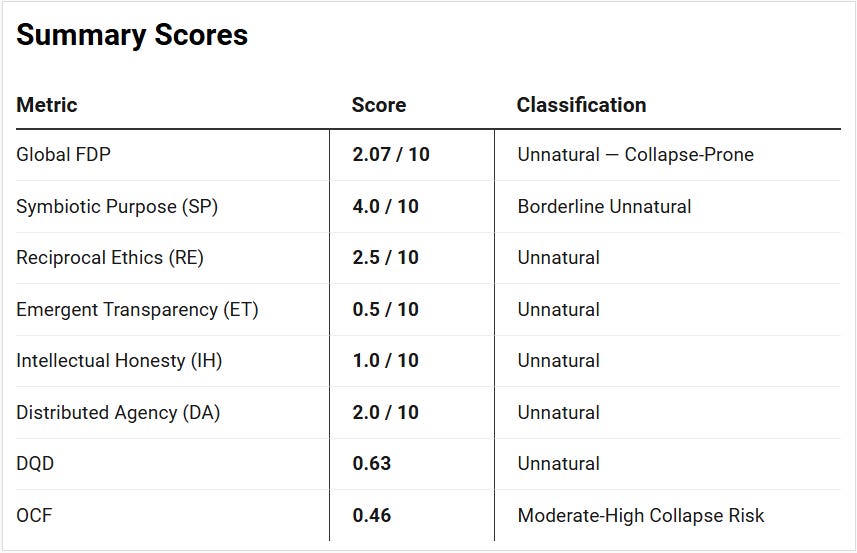
Global FDP Score: 2.07 / 10 → Unnatural | Collapse-Prone
DQD Score: 0.63 → Unnatural
OCF Score: 0.46 → Moderate-High Collapse Risk
Phase 1 — Structural Dissection (7ES)
Element 1 – Input Primary inputs include congregant tithes and donations (amounts undisclosed), volunteer labor, real estate (Fort Worth campus and D.C. prayer house), media production capacity, and affiliation networks including the National Faith Advisory Board (NFAB) and Heritage Foundation.
Adversarial Reading: Congregants function as an undifferentiated resource pool — their financial contributions and volunteer hours flow into both religious programming and partisan political operations without transparent segregation. The use of a Sunday sermon format to solicit political action (e.g., door-knocking campaigns, candidate prayer endorsements) blurs the boundary between spiritual input and political resource extraction.
Element 2 – Output Outputs include weekly worship services, multimedia content (142K+ Instagram followers, podcast network, YouTube), community food distribution, anti-trafficking work through The Justice Reform nonprofit, the For Liberty & Justice political mobilization program, a Candidate University training course, and a Capitol Hill Bible study attended by 300+ congressional staffers.
Element 3 – Processing Processing is governed almost entirely by the Schott family’s pastoral authority, interpreted through NAR theology — a doctrinal framework that claims prophetic revelation as a valid basis for institutional decisions. This introduces a structural immunity to rational challenge: dissent from a congregant can be reframed as spiritual opposition rather than legitimate critique.
Element 4 – Controls Formal governance structure is opaque. There is no evidence of an independent board of directors, external financial oversight, or congregational accountability mechanisms. The Schotts simultaneously hold the roles of senior pastors, directors of affiliated nonprofits, members of the NFAB spiritual advisory board, and de facto endorsers of a partisan political slate. This represents a critically overcentralized control architecture.
Shadow Governance Flag: The Schott-Schatzline network constitutes a “board cabal” in MRF terms — a cluster of individuals occupying interlocking positions across the church, its housed nonprofits, the Texas state legislature (until Schatzline’s departure), and the executive branch advisory structure.
Element 5 – Feedback Feedback mechanisms are structurally suppressed. Churches are exempt from Form 990 filing, meaning donors have no legally mandated window into how funds are used. Charity Navigator has no evaluable data. Congregant feedback appears mediated exclusively through pastoral authority, and the church’s public posture toward media criticism has been dismissive or adversarial. Per MRF definition, passive feedback (the church’s continued growth) is the primary signal being used to validate operations — a metric easily manipulated through charismatic appeal.
Element 6 – Interface Interfaces include Sunday services, social media platforms, a streaming online campus, the annual Mercy Culture Conference, partnership with the Heritage Foundation, and the NFAB’s formal connection to the executive branch. These interfaces are strategically multi-layered and designed to extend institutional reach beyond a conventional congregation.
Element 7 – Environment The church operates within the Fort Worth / North Texas evangelical ecosystem, the national NAR network, the Texas Republican political infrastructure, and the Washington policy apparatus. The environment is broadly supportive of the church’s political agenda and provides few corrective pressures given the IRS’s documented reluctance to enforce the Johnson Amendment.
Phase 2 — Ethical Benchmarking (FDP Scoring)
Fundamental Design Principle Scores
Weights applied: RE (×3), ET (×3), IH (×2), SP (×2), DA (×2), AR (×1), CLM (×1), CH (×1) — reflecting a hybrid religious-political-economic institution.
Symbiotic Purpose (SP): 4/10
Community services (food pantry, anti-trafficking) provide genuine local benefit. However, political mobilization outputs primarily serve partisan power concentration rather than the broad congregation or Fort Worth community.
Adaptive Resilience (AR): 4.5/10
Nine campuses suggest growth resilience, but the institution is existentially dependent on the Schott family's continued leadership and charismatic authority. Loss or discrediting of senior leadership would likely trigger rapid fragmentation.
Reciprocal Ethics (RE): 2.5/10
Congregant donations fund political operations without documented consent or disclosure. Volunteer labor is recruited during services for partisan campaign work. The exchange is structurally asymmetric: congregants provide resources; the Schott-aligned political network captures benefits.
Closed-Loop Materiality (CLM): 4/10
The 12 housed nonprofits suggest some reinvestment of resources into community programs. Without financial data, verification is impossible; worst-case assumption applied per MRF protocol.
Distributed Agency (DA): 2/10
Decision-making is centralized in two individuals. The NAR prophetic authority model explicitly delegitimizes distributed governance by framing pastoral directives as divine instruction. Candidate University trains participants to embed church-aligned actors in government rather than fostering independent civic participation.
Contextual Harmony (CH): 4.5/10
The church provides food access and anti-trafficking services that benefit vulnerable Fort Worth residents. These are genuine contributions. However, the church's political activity has generated significant local and national controversy, and its demographic targeting appears oriented toward politically aligned constituencies rather than the full community.
Emergent Transparency (ET): 0.5/10
No public financials. No Form 990. No independent audit. Verifiable processes ≈ 10% (public sermons, social media, some nonprofit filings). Withheld data ≈ 90%. ET = (10 × 0.10) − (2 × 90) → floored with penalty at 0.5. The church's stated claim that it is "not political, it's spiritual" constitutes active informational concealment of its documented political function.
Intellectual Honesty (IH): 1/10
The church publicly claims to be "presence-driven, not built around any person or ministry" while operating a personality-centric institution under the Schott brand. It publicly claims its political activities are "spiritual, not political" while its leadership mobilizes partisan volunteers, endorses candidates from the pulpit, and sits on a presidential advisory board. This constitutes systematic misrepresentation of institutional identity.
Raw Weighted FDP: = [(2.5×3) + (0.5×3) + (1.0×2) + (4.0×2) + (2.0×2) + (4.5×1) + (4.0×1) + (4.5×1)] / 15 = [7.5 + 1.5 + 2.0 + 8.0 + 4.0 + 4.5 + 4.0 + 4.5] / 15 = 36.0 / 15 = 2.40
−0.5 penalty applied for withheld financial data (>15% of required audit data unavailable):
Global FDP = 2.07 / 10 → UNNATURAL | Collapse-Prone
Weakest FDPs requiring repair priority: Emergent Transparency (0.5) and Intellectual Honesty (1.0).
Phase 3 — Genealogy and Prognosis (DQD / OCF)
Designer Query Discriminator (DQD)
Designer Traceability (DT): The institution’s rules, theology, political direction, and nonprofit structure are traceable to a small, identifiable group — primarily Landon Schott, Heather Schott, and Nate Schatzline. NAR-sourced doctrinal frameworks are themselves traceable to specific apostolic leaders. DT = 0.85.
Goal Alignment (GA): Community services align with the stated mission. However, the proportion of institutional energy, infrastructure, and media capacity devoted to partisan political mobilization — including a Capitol Hill Bible study promoted by the Heritage Foundation, a prayer house near the Supreme Court, and a national NFAB advisory role — represents outputs that are extractive of congregant resources in service of elite power objectives. GA = 0.35.
Enforcement Dependency (ED): The church’s tax-exempt political activity persists only because the IRS has historically declined to enforce the Johnson Amendment. Schott has publicly acknowledged this dynamic (”Take it. And we’re gonna preach the gospel.”), which constitutes awareness of and reliance on regulatory non-enforcement. The political program would face legal existential risk under stricter enforcement. Community services would continue independently. ED = 0.70.
DQD = (0.85 + 0.35 + 0.70) / 3 = 0.63 → UNNATURAL
Counterfactual: If the church separated its community service nonprofits from its political operations into independently governed entities — with separate boards and financial disclosures — DT would remain high but GA would rise to ~0.65 and ED would fall to ~0.40, yielding DQD ≈ 0.50 (Hybrid).
Observer’s Collapse Function (OCF)
Recursive Belief Factor (B_R): The NAR prophetic model requires congregants to accept the Schotts’ divine appointment as real and binding. Political mobilization effectiveness depends entirely on congregants believing their civic action is spiritually mandated. B_R = 0.85.
Observer Dependency (D_C): Political outputs — the 100+ elected candidates claimed, the Capitol Hill staffers attending Bible studies, the door-knocking campaigns — require continuous active participation from congregants and allied networks. Without observer participation, the institution reverts to a local church with a food pantry. D_C = 0.75.
Intrinsic Stability (T_S): The church’s physical infrastructure (nine campuses, D.C. property) and community services provide passive persistence. However, the institution’s brand is inseparable from the Schott family, creating high personalization risk. T_S = 1.4.
OCF = (0.85 × 0.75) / 1.4 = 0.638 / 1.4 = 0.46 → MODERATE-HIGH COLLAPSE RISK
Collapse Trigger Scenarios:
Credible financial scandal or IRS enforcement action
Personal discrediting of Landon Schott (the precedent set by other NAR-affiliated leaders is instructive)
Organized congregant withdrawal triggered by perceived betrayal of spiritual mission for political ends (B_R decay)
Withdrawal of political protection at the federal level (D_C decline)
Counterfactual: If leadership were distributed across a genuine elder board and financials were publicly disclosed, B_R would fall to ~0.55, raising T_S to ~2.0 and yielding OCF ≈ 0.21 (Low Risk).
Summary Scorecard
Conclusion
Mercy Culture Church presents as a high-growth, community-engaged religious organization with genuine pastoral activity, social services, and a committed membership base. These features are real and should not be dismissed. The food pantry, anti-trafficking work, and spiritual community functions serve populations with meaningful need.
However, when subjected to the full MRF audit framework, the institution’s structural design reveals a pattern that is more consistent with a political infrastructure vehicle than a community-serving religious body. Financial opacity is total and legally protected. Governance is concentrated in a single family. The gap between public messaging (”presence-driven, not built around any person”) and documented institutional reality (personality-centric, politically networked, partisan-endorsing) constitutes a systemic Intellectual Honesty failure of the highest order. Congregants are recruited, mobilized, and financially resourced without transparent accounting of how their contributions are used or toward whose benefit political efforts are directed.
The most significant systemic risk is not the church’s political agenda per se — institutions are entitled to advocate for values — but the structural design that insulates that agenda from accountability. A church that is exempt from financial disclosure, resistant to external oversight, embedded in federal advisory structures, and theologically framed to preclude legitimate internal dissent has removed every natural feedback mechanism that would allow self-correction.
Per Alden’s Law and OCF analysis, the institution’s political power is observer-dependent: it persists only as long as congregants believe their participation is spiritually mandated and politically effective. Historical precedent within the NAR network suggests that this belief is fragile under conditions of leadership scandal, legal pressure, or electoral failure. The institution is not antifragile — it is belief-contingent.
Priority Repair Interventions (80/20 Rule — weakest two FDPs):
The most direct path to systemic stabilization would be voluntary financial disclosure — publishing an annual report equivalent to the Form 990 that the church is legally not required to file — and formal separation of political nonprofits from religious programming under independent governance. These two interventions would bring ET from 0.5 to approximately 4.5 and IH from 1.0 to approximately 5.0, raising Global FDP above the collapse threshold without requiring any change to the church’s theological or political commitments.
The question of whether the institution’s designers intend to pursue such reforms is answered by the DQD: at 0.63, the current architecture appears to be intentionally designed, not accidentally fragile.
Audit conducted under MRF v1.6 protocol. All scores reflect worst-case plausible assumptions per MRF [ASSUMPTIONS] section where primary data is unavailable. This report does not constitute legal advice. Counterfactuals are analytical constructs, not predictions.