

What are Biomimetic Protocols?
They Translate the Operational Architecture of Natural Systems into Actionable Repair Pathways

Introduction
Biomimetic Repair Protocols are structured intervention strategies derived from natural system design patterns that address specific deficiencies identified through Fundamental Design Principle scoring. These protocols translate the operational architecture of natural systems that demonstrate high viability and resilience into actionable repair pathways for human-designed systems exhibiting dysfunction or collapse risk.
The term combines two essential components.
Biomimetic refers to the practice of emulating nature’s time-tested patterns and strategies, recognizing that natural systems have solved complex organizational challenges across billions of years of evolutionary refinement.
Repair Protocol indicates a systematic, implementable set of interventions designed to transform a system’s architecture from extractive or unstable configurations toward regenerative patterns that align with the eight Fundamental Design Principles observed in viable natural systems.
Function and Purpose
Biomimetic Repair Protocols serve multiple interconnected functions within the broader KOSMOS framework of systemic transformation. Their primary purpose is providing actionable pathways from diagnosed dysfunction to demonstrated viability, converting abstract Fundamental Design Principle scores into concrete implementation roadmaps that organizations can follow with reasonable confidence in outcomes.
The protocols function as translation mechanisms that bridge the substantial gap between recognizing system failure and understanding how to repair it.
Many organizations and policymakers can identify when systems are not working but lack structured methodologies for redesigning toward better outcomes. Biomimetic Repair Protocols address this implementation gap by offering proven design templates derived from natural systems that have already solved similar organizational challenges through evolutionary testing across vast timescales.
This provides a form of empirical validation that purely theoretical reform proposals cannot match, because the proposed interventions emulate patterns that demonstrably work in nature rather than representing untested human innovations.
The protocols also serve an educational function by making visible the specific architectural features that distinguish viable systems from dysfunctional ones.
When stakeholders can observe concrete comparisons between their current institutional design and the natural system template being proposed as a repair model, they develop clearer understanding of why their system generates problematic outcomes.
A corporation recognizing that its 650-to-1 executive compensation ratio has no natural analogue in any sustainable system across billions of years of evolutionary history confronts a different quality of evidence than abstract arguments about fairness or justice. The thermodynamic impossibility of maintaining such asymmetry in viable systems becomes an empirical observation rather than an ideological claim.
Additionally, Biomimetic Repair Protocols function as risk mitigation tools by enabling computational modeling of proposed reforms before capital commitment to implementation. Organizations can evaluate how specific interventions would affect their Fundamental Design Principle scores through scenario analysis, comparing multiple potential redesign pathways against each other and against natural system benchmarks.
This de-risks transformation by allowing leadership to test alternatives, identify implementation sequences, and anticipate resistance points or unintended consequences before making irreversible changes to operational architecture.
Relationship to Other KOSMOS Framework Components
Biomimetic Repair Protocols function as the action-oriented complement to the diagnostic capabilities of the Seven Element Structure, Fundamental Design Principles, Designer Query Discriminator, and Observer Collapse Function analyses.
Where those tools identify what is wrong with existing systems and why they exhibit dysfunction, the protocols specify how to reconstruct toward viable alternatives. This diagnostic-to-prescriptive sequence creates a complete analytical cycle from system audit through transformation planning to implementation guidance.
The protocols also demonstrate the practical application of Alden’s Law that no observers → no economy, everything else being merely human-designed assumptions.
By grounding repair strategies in natural system patterns that persist independent of human belief or institutional power, the protocols circumvent the ideological capture that often constrains conventional reform efforts. When interventions derive authority from thermodynamic necessity rather than political consensus, they prove more durable against the erosion that typically undermines human institutional innovations over time.
Determination Process
Biomimetic Repair Protocols emerge through a structured analytical process that begins with comprehensive system auditing using the KOSMOS Framework tools. The Seven Element Structure maps the complete architecture of the system under examination, identifying inputs, outputs, processing mechanisms, controls, feedback loops, interfaces, and environmental interactions.
The Fundamental Design Principles scoring then quantifies the system’s alignment with natural viability patterns across eight dimensions including Symbiotic Purpose, Adaptive Resilience, Reciprocal Ethics, Closed-Loop Materiality, Distributed Agency, Contextual Harmony, Emergent Transparency, and Intellectual Honesty.
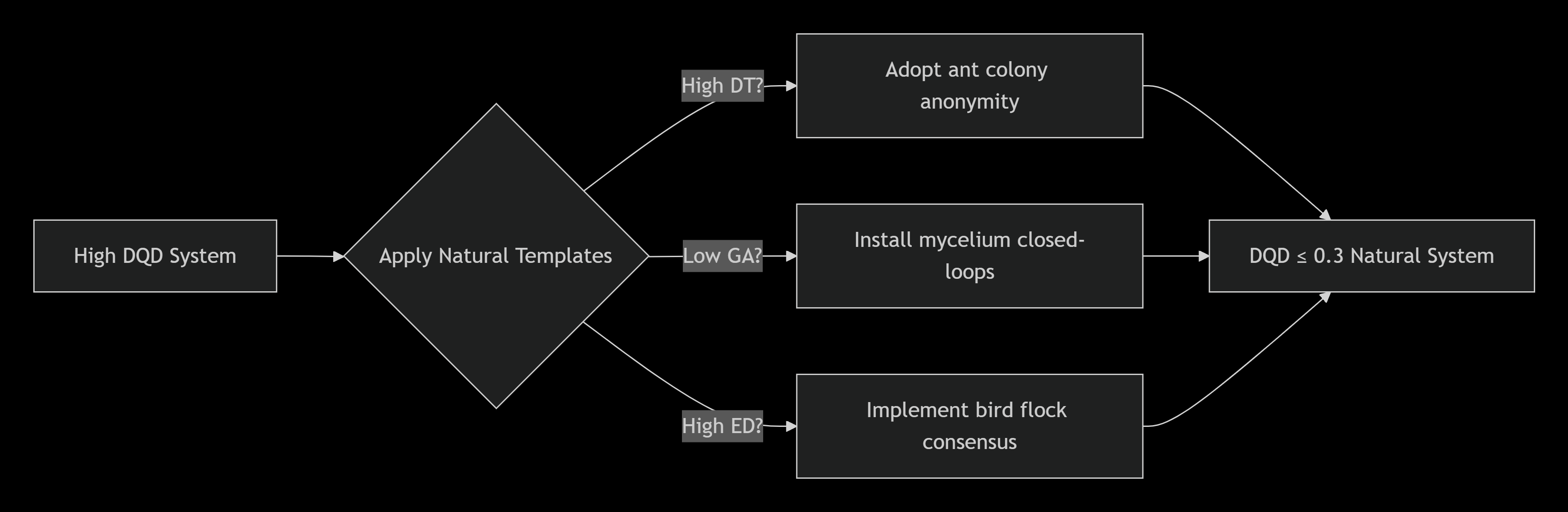
Once audit analysis identifies which Fundamental Design Principles exhibit the most severe deficits, the protocol development process searches for natural system analogues that demonstrate exceptional performance on those specific principles.
The selection criteria prioritize natural systems that operate at comparable scales, handle similar functional requirements, or face analogous environmental pressures to the human system requiring repair.
A manufacturing supply chain with severe Closed-Loop Materiality deficits might be analyzed against mycorrhizal nutrient cycling networks or coral reef symbiotic relationships. A media organization failing Intellectual Honesty benchmarks might be studied against adaptive immune system discrimination mechanisms or evolutionary fitness testing processes.
The translation from natural template to human implementation requires careful analysis of the underlying mechanisms that enable the natural system’s superior performance. Rather than superficially copying surface features, the protocol development identifies the core operational principles that generate the desired outcomes.
An immune system does not rely on centralized authority to distinguish threats from healthy tissue but instead employs distributed verification requiring multiple independent confirmation signals before mounting full responses.
This principle of distributed verification with redundant confirmation can be translated into human organizational contexts through specific procedural reforms, oversight structures, and decision-making architectures that embody the same fundamental logic while accounting for the constraints and capabilities of human institutions.
Importance and Strategic Value
The importance of Biomimetic Repair Protocols derives from their capacity to convert systemic critique into systemic transformation. Many analytical frameworks excel at diagnosing institutional dysfunction but provide limited guidance about reconstruction. The KOSMOS Framework addresses this implementation gap by pairing rigorous diagnostic capability with structured repair methodology grounded in natural system wisdom rather than untested human theory.
Biomimetic Repair Protocols prove particularly valuable in contexts where stakeholders disagree about values or priorities but can potentially find common ground in empirical observation of what actually works across evolutionary timescales. Political debates about economic policy often devolve into ideological conflicts between competing value systems that prove impossible to resolve through rational discourse.
However, when analysis demonstrates that certain institutional architectures consistently fail to persist in nature while alternative configurations demonstrate robust viability, the conversation shifts from values to evidence. Thermodynamic principles and evolutionary testing provide non-negotiable constraints that transcend human ideology, creating a form of authority that political compromise cannot easily dismiss.
The protocols also provide strategic value by enabling what might be termed evolutionary acceleration. Natural selection produces viable system architectures through gradual refinement across countless generations involving substantial trial and error with high mortality rates for failed experiments.
Human institutions cannot afford this timescale or failure rate. Biomimetic Repair Protocols compress billions of years of evolutionary learning into implementable interventions that allow human systems to adopt proven design patterns without requiring the extensive testing periods that produced those patterns originally. This represents a form of legitimate shortcut grounded in empirical validation rather than speculative innovation.
For activist organizations and social movements, Biomimetic Repair Protocols transform external pressure campaigns from purely oppositional stances into constructive alternatives. Rather than simply demanding that institutions stop harmful practices without offering viable replacement pathways, movements deploying these protocols can present specific, evidence-based redesign roadmaps that address legitimate operational concerns while eliminating extractive features.
This dual capability creates strategic advantages by making transformation simultaneously more compelling to reform-minded institutional actors and more difficult for defenders of current systems to dismiss as impractical idealism.
From an investment and philanthropic perspective, Biomimetic Repair Protocols provide infrastructure for evaluating which institutional reforms deserve capital allocation based on their alignment with proven natural viability patterns.
Rather than funding experimental interventions with uncertain outcomes, investors can deploy resources toward transformations that emulate natural templates with demonstrated long-term success. This shifts impact investment from high-risk speculation to evidence-based strategic positioning, potentially accelerating capital flows toward genuinely regenerative economic models.
Example Applications
The application of Biomimetic Repair Protocols varies substantially across system types and contexts, but several representative examples illustrate the methodology in practice.
A media organization scoring critically low on Intellectual Honesty due to systematic concealment of conflicts of interest, absence of error correction mechanisms, and false equivalence framing might deploy protocols derived from adaptive immune systems, evolutionary fitness testing, and mycorrhizal information networks.
The immune system template suggests conflict disclosure architecture that distinguishes self from non-self without systematic bias. The evolutionary template indicates correction architecture that preserves accurate predictions while eliminating failed forecasts through competitive selection pressure. The mycorrhizal template provides transparency mechanisms that transmit information without distortion across distributed networks.
These natural analogues translate into specific interventions including mandatory disclosure of financial relationships, systematic tracking of prediction accuracy with source prominence adjusted accordingly, and structural separation between editorial and commercial operations.
A manufacturing corporation exhibiting severe Closed-Loop Materiality deficits resulting from linear take-make-dispose production models could implement protocols derived from forest nutrient cycling or mycelium decomposition networks.
These natural systems achieve zero-waste operation through complementary relationships where one organism’s outputs serve as another’s inputs, creating closed loops at multiple scales simultaneously. Translation to industrial contexts suggests supplier network redesign where production waste from one facility becomes feedstock for another, packaging material selection prioritizing biodegradability or technical recyclability, and product design incorporating planned material recovery pathways from initial engineering phases.
The protocol would specify implementation sequences starting with highest-volume waste streams, partnership development criteria for symbiotic supplier relationships, and metrics for measuring progress toward closed-loop operation benchmarked against natural system efficiency.
A financial institution demonstrating pathological asymmetry in Reciprocal Ethics through extreme compensation ratios and extractive fee structures might apply protocols derived from eusocial insect colonies or forest canopy resource distribution patterns.
While these natural systems exhibit functional differentiation and hierarchical organization, resource distribution remains constrained within ranges that serve colony or ecosystem survival rather than individual accumulation.
Implementation would involve compensation architecture reform linking executive pay to median worker compensation at ratios observed in viable natural systems, fee structure redesign distributing transaction costs more equitably across stakeholders, and governance modifications that increase stakeholder representation in strategic decision-making.
The protocol would model how different ratio adjustments affect overall system resilience scores while maintaining operational effectiveness, providing empirical foundation for specific reform thresholds.
These examples demonstrate how Biomimetic Repair Protocols convert abstract Fundamental Design Principle deficits into concrete, implementable interventions grounded in patterns proven viable through billions of years of natural system evolution.
The methodology’s power derives from its dual grounding in rigorous diagnostic analysis and empirically validated natural templates, creating transformation pathways that prove simultaneously theoretically sound and practically achievable.
Implementation Context and Limitations
While Biomimetic Repair Protocols offer substantial advantages over conventional reform methodologies, their effective deployment requires acknowledgment of inherent limitations and contextual considerations.
Natural systems operate within physical constraints and selective pressures that differ in important ways from human institutional environments. Translating biological principles into organizational contexts demands careful attention to these differences rather than simplistic copying of natural features without regard for functional appropriateness.
The protocols work most effectively when applied to systems exhibiting severe misalignment with multiple Fundamental Design Principles simultaneously, because such systems typically demonstrate clear dysfunction that creates internal demand for transformation alongside external pressure.
Organizations performing adequately by conventional metrics while scoring poorly on natural system benchmarks may resist protocol implementation despite theoretical benefits, because the immediate costs of restructuring exceed perceived urgency. This suggests that protocol deployment should prioritize failing systems where stakeholders already recognize the need for fundamental change, using early successes to demonstrate viability before attempting application to more resistant contexts.
Additionally, Biomimetic Repair Protocols require sustained implementation commitment across sufficient timescales to allow new architectures to stabilize and demonstrate their advantages. Natural systems develop their characteristic patterns through iterative refinement that human institutions must replicate through deliberate organizational development rather than expecting immediate results.
Leadership turnover, political pressures, or financial volatility can interrupt implementation before protocols generate measurable improvements, creating risk of partial deployment that fails to achieve intended outcomes. Successful application therefore requires governance structures and stakeholder alignment sufficient to maintain strategic consistency across multi-year transformation periods.