
The 7ES Framework as Universal Scientific Grammar
Enabling Cross-Disciplinary Communication and Integration

Core System Definition
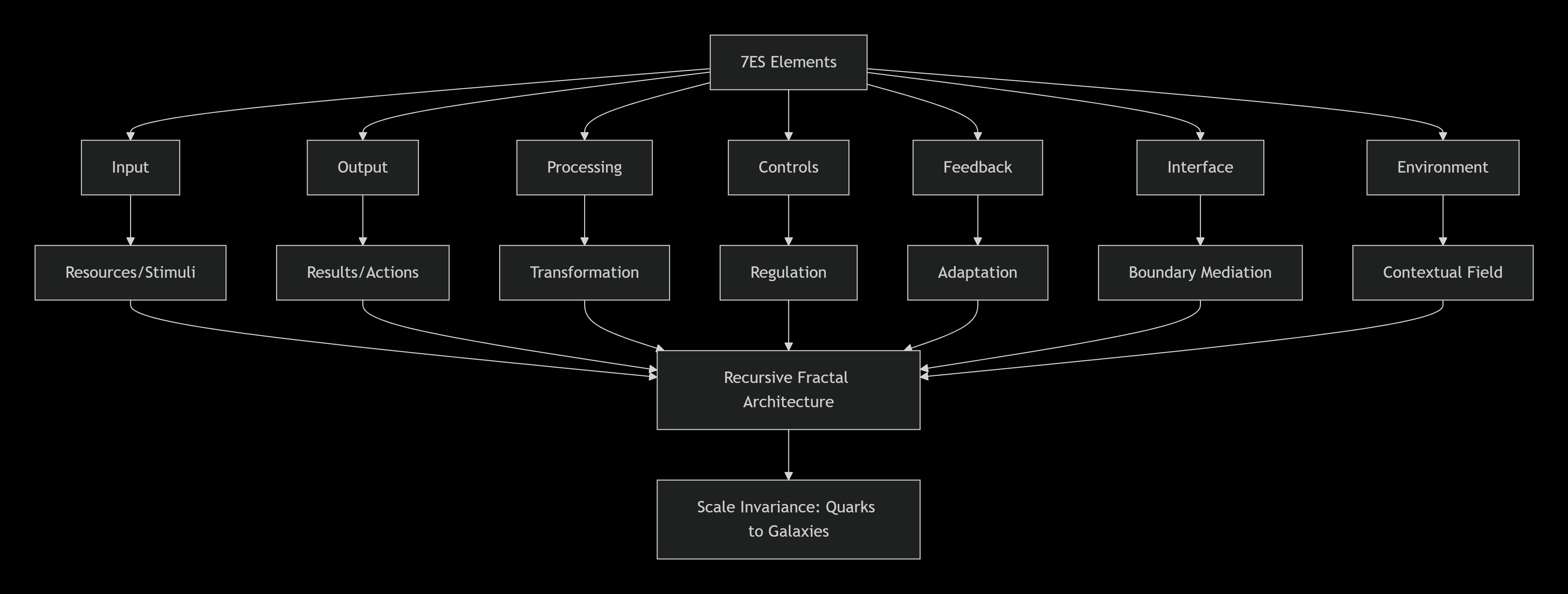
System = An organized arrangement of components exhibiting input acquisition, output generation, internal processing, behavioral constraints (controls), state information flow (feedback), boundary mediation (interface), and environmental context (environment). A system is distinguished from random collections of objects by the presence of all seven fundamental elements working in coordination to create emergent properties and behaviors.
The Communication Barrier Across Scientific Disciplines
Modern science has achieved remarkable depth of understanding within specialized domains, yet this specialization has created profound communication barriers that limit collaborative potential and slow innovation.
A physicist studying quantum field dynamics and a biologist studying cellular signaling networks possess complementary insights about information processing systems, but they lack a common analytical vocabulary that would enable productive exchange. Their respective fields have developed domain-specific terminologies, mathematical formalisms, and conceptual frameworks that serve internal communication excellently while creating nearly impenetrable barriers to external collaboration.
This fragmentation imposes significant costs on scientific progress.
Researchers working on analogous problems in different domains cannot easily recognize the parallels or transfer solutions. Interdisciplinary teams struggle to establish common ground because participants literally speak different scientific languages.
Graduate students must invest years learning new terminologies and frameworks when crossing disciplinary boundaries, even when studying fundamentally similar phenomena. Innovation that requires integrating insights across domains proceeds slowly because translation between specialized vocabularies requires extensive effort and often introduces misunderstandings.
The 7ES Framework addresses this challenge by providing a universal analytical grammar that operates across all scientific domains.
Just as mathematical notation enables communication across human languages, the seven-element structure enables communication across scientific disciplines. Every domain studies systems that receive inputs, process information, produce outputs, operate under constraints, monitor their own function, manage boundaries, and exist within broader contexts. The specific mechanisms differ dramatically, but the functional architecture remains consistent.
This consistency creates the foundation for systematic translation and productive collaboration.
Physics: Field Dynamics and Particle Interactions
Physicists study phenomena ranging from quantum mechanics to cosmology using mathematical frameworks that emphasize symmetries, conservation laws, and field equations. The discipline has developed extraordinary precision in describing physical interactions, but this precision comes wrapped in formalism that makes communication with other sciences challenging.
The 7ES Framework provides translation without sacrificing rigor.
Consider quantum field theory, which describes particle interactions through fields permeating spacetime. Within the 7ES framework, these interactions map clearly onto the seven-element structure. The Input element encompasses field excitations and boundary conditions that specify the initial state of the system. The Processing element includes the field equations themselves—differential equations that govern how fields evolve and interact according to fundamental symmetries and conservation principles. The Output element manifests as observable particle creation, scattering amplitudes, and measurement outcomes that experimentalists detect.
The Controls element in quantum systems operates through symmetries and conservation laws that constrain what transformations are physically possible. Gauge symmetries require certain relationships between field components. Energy-momentum conservation limits what processes can occur. These controls are not external constraints imposed on the system but intrinsic features that define physically realizable configurations.
The Feedback element appears through quantum entanglement and measurement back-action, where observation of one system component affects the state of others. The Interface element operates at boundaries between quantum and classical descriptions, where decoherence and measurement occur. The Environment element encompasses the broader quantum field context within which specific interactions take place.
This translation enables physicists to communicate their work to other disciplines without requiring years of mathematical physics training. A biologist can understand that quantum field interactions process information about field states to produce particle outputs, constrained by symmetries, with feedback through entanglement, managing interfaces at measurement boundaries, within the environment of quantum fields.
The specific mathematical machinery remains physics-specific, but the functional architecture becomes comprehensible across disciplines.
Biology: Cellular Systems and Evolutionary Dynamics
Biological systems operate through mechanisms evolved over billions of years, creating organizational complexity that often appears irreducible to physical principles.
The 7ES Framework reveals that this complexity emerges from recursive application of the same seven-element structure at multiple organizational levels, enabling biologists to communicate system architecture to other disciplines while providing analytical tools for examining biological phenomena.
Consider cellular signal transduction cascades, which convert external chemical signals into internal cellular responses. The Input element consists of ligand molecules binding to cell surface receptors, providing information about environmental conditions. The Processing element includes the cascade of protein phosphorylation reactions that amplify and transform the initial signal through specific biochemical pathways. The Output element manifests as changes in gene expression, metabolic activity, or cellular behavior that constitute the cell’s response to the external signal.
The Controls element operates through multiple regulatory mechanisms. Positive feedback amplifies signals when appropriate. Negative feedback prevents excessive response. Protein kinases and phosphatases create activation and deactivation cycles. Regulatory proteins modulate pathway sensitivity. These controls ensure that cellular responses match environmental conditions appropriately rather than responding chaotically to every minor perturbation.
The Feedback element monitors system state through multiple sensing mechanisms, from substrate concentration to second messenger levels, enabling continuous adjustment of processing parameters. The Interface element manages the cell membrane boundary where external signals must be detected and converted into internal processing mechanisms. The Environment element encompasses both the extracellular milieu providing signals and the intracellular context including other signaling pathways and cellular resources.
When translated into 7ES terms, cellular signaling becomes directly comparable to information processing systems in other domains. An engineer can recognize the architecture immediately—inputs detected at interfaces, processed through cascades with feedback regulation, producing outputs that modify system state.
This recognition enables transfer of engineering control theory concepts to biological systems and biological adaptation strategies to engineered systems, facilitated by the common analytical framework.
Chemistry: Reaction Networks and Molecular Dynamics
Chemistry occupies a middle position between physics and biology, studying molecular interactions and transformations that bridge from quantum mechanical descriptions to complex biochemical processes. Chemical systems demonstrate 7ES architecture with particular clarity because reaction networks explicitly show inputs, transformations, outputs, and regulatory mechanisms.
The Belousov-Zhabotinsky oscillating reaction provides an instructive example. The Input element includes the reactant species—bromate oxidizer, malonic acid substrate, catalyst ions, and acid concentration—that provide the material and energetic resources driving the system. The Processing element consists of three coupled reaction pathways that cyclically transform reactants through different chemical intermediates. Each pathway operates through specific kinetic mechanisms with characteristic rate constants and concentration dependencies.
The Output element manifests as oscillating concentrations of intermediate species, color changes visible to observers, and spatial wave patterns when the reaction occurs in extended media. These outputs provide direct observation of the system’s processing state. The Controls element operates through thermodynamic constraints that determine which reactions are energetically favorable, kinetic parameters that set reaction rates, and stoichiometric relationships that ensure mass and charge conservation. These controls channel the system toward specific oscillatory patterns rather than allowing random transformation.
The Feedback element creates the oscillatory behavior through concentration-dependent reaction rates. When bromide concentration rises above threshold, it inhibits one pathway while activating another. When bromide drops below threshold, the activation pattern reverses. This feedback coupling between reaction pathways and intermediate concentrations creates the sustained oscillation.
The Interface element manages boundaries between the reaction solution and its surroundings, determining how the system exchanges heat and material with the environment. The Environment element includes the solution matrix, container geometry, temperature, and ambient conditions that influence reaction dynamics.
This 7ES decomposition enables chemists to communicate with physicists about energy landscapes and reaction coordinates while simultaneously communicating with biologists about metabolic oscillations and pattern formation.
The framework provides the translation layer that makes interdisciplinary conversation productive rather than requiring each party to first master the other’s specialized formalism.
Neuroscience: Neural Networks and Cognitive Processing
Neuroscience studies nervous systems at scales from individual synapses to whole-brain dynamics, generating insights about information processing, learning, and cognition that remain difficult to integrate with understanding from other domains.
The 7ES Framework enables neuroscientists to position their findings within broader frameworks of computation and complexity while providing other disciplines access to neuroscientific insights.
Consider neural circuits processing sensory information. The Input element encompasses sensory receptors that transduce physical stimuli—photons, mechanical pressure, chemical concentrations—into electrical signals. Different receptor types sample different aspects of the environment, creating parallel input channels with specialized sensitivities. The Processing element includes the hierarchical neural networks that transform raw sensory inputs into progressively more abstract representations through successive stages of integration and extraction.
The Output element manifests as motor commands, hormonal signals, and higher-level cognitive states that constitute the nervous system’s response to sensory information. These outputs may be immediate reflexes or deliberated decisions, depending on the processing pathways engaged. The Controls element operates through neuromodulation—chemical signals that adjust neural responsiveness, synaptic efficacy, and network excitability based on behavioral state and internal goals. These modulatory controls enable the same neural circuits to process information differently under different conditions.
The Feedback element appears through multiple mechanisms spanning different timescales. Immediate feedback occurs through recurrent connections within neural circuits. Intermediate feedback operates through synaptic plasticity that adjusts connection strengths based on activity patterns. Long-term feedback involves structural changes including neuron growth and circuit reorganization.
The Interface element manages boundaries between nervous system and body, including the blood-brain barrier that controls chemical exchange and sensory surfaces where physical stimuli become neural signals. The Environment element encompasses both the external world being sensed and the internal bodily context including hormonal state, metabolic resources, and other organ systems.
This framework enables productive conversation between neuroscientists and computer scientists studying artificial neural networks, between neuroscientists and biologists studying other signaling systems, and between neuroscientists and physicists studying complex dynamics.
The 7ES structure reveals that all are studying variations on information processing architectures that differ in substrate and mechanism but share fundamental organizational principles.
Economics: Markets and Institutional Dynamics
Economic systems create coordination through distributed mechanisms including markets, firms, and regulatory institutions. Economists have developed sophisticated mathematical tools for analyzing these mechanisms, but the specialized nature of economic modeling creates barriers to integration with other social and natural sciences.
The 7ES Framework provides the translation layer enabling economists to communicate with other disciplines, while gaining analytical tools from domains studying analogous coordination challenges.
Consider market systems coordinating production and consumption. The Input element includes consumer preferences, resource availability, technological capabilities, and regulatory constraints that define what economic activity is possible and desirable.
The Processing element consists of the price mechanisms, production decisions, investment choices, and trade relationships through which markets transform inputs into allocative outcomes. Firms process information about costs and revenues to determine production. Consumers process price signals to determine purchases. Financial markets process information about future prospects to determine investment flows.
The Output element manifests as resource allocation patterns, production volumes, employment levels, and wealth distributions that constitute the economic system’s actual performance. These outputs affect individual welfare, social stability, and environmental impacts. The Controls element operates through regulatory frameworks, property rights, contract enforcement, monetary policy, and competitive pressures that constrain economic behavior.
Well-designed controls channel economic activity toward socially beneficial outcomes while poorly designed controls create perverse incentives and inefficiency.
The Feedback element appears through market signals—prices that rise when demand exceeds supply and fall when supply exceeds demand, profits that grow when firms meet needs efficiently and shrink when they waste resources, wages that adjust based on labor market conditions. These feedback mechanisms theoretically guide the system toward equilibrium, though actual dynamics often exhibit instability and crisis.
The Interface element manages exchanges between the monetized economy and non-market systems including household production, environmental resources, and social institutions. The Environment element encompasses the natural resources, technological possibilities, cultural values, and geopolitical context within which economic systems operate.
This translation enables economists to engage with ecologists studying resource dynamics, with engineers studying optimization and control, with physicists studying complex adaptive systems, and with sociologists studying institutional evolution.
The common framework reveals that markets are information processing systems with particular characteristics rather than sui generis phenomena requiring completely specialized analytical approaches.
Computer Science: Algorithms and Computational Systems
Computer science studies information processing through designed systems, providing both theoretical frameworks for understanding computation and practical systems that perform useful work. The discipline has developed rigorous mathematical foundations, but these foundations sometimes obscure the connections between computational systems and natural information processing.
The 7ES Framework makes these connections explicit while providing computer scientists with validated design patterns from natural systems.
Consider a web service processing user requests. The Input element encompasses incoming HTTP requests containing user data, authentication credentials, and processing instructions. Different input types—queries, updates, file uploads—require different processing pathways. The Processing element includes the application logic that interprets requests, accesses databases, performs computations, and generates responses. This processing may be simple data retrieval or complex machine learning inference depending on the service architecture.
The Output element manifests as HTTP responses containing requested data, status codes indicating success or failure, and side effects including database modifications or triggered workflows. The Controls element operates through multiple layers including input validation that rejects malformed requests, access control that enforces security policies, rate limiting that prevents resource exhaustion, and business logic that constrains what operations are permissible.
These controls ensure that processing remains within designed parameters.
The Feedback element appears through monitoring systems that track performance metrics, error rates, and resource utilization. This feedback triggers automated responses including scaling computational resources, routing requests to alternative systems when primary systems fail, and alerting human operators about anomalous conditions. The Interface element consists of API specifications, data formats, authentication mechanisms, and network protocols that manage communication between the system and external entities.
The Environment element includes the infrastructure supporting computation—servers, networks, databases—plus the broader ecosystem of dependent and supporting services.
This decomposition enables computer scientists to learn from biological and physical systems about robust information processing under uncertainty. It enables biologists to apply computational concepts to cellular systems. It enables economists to recognize parallels between algorithmic optimization and market mechanisms.
The common framework facilitates transfer of insights and techniques across domains that previously required extensive translation effort.
Enabling Cross-Disciplinary Communication: Concrete Examples
The value of 7ES as universal grammar becomes most apparent when examining specific cross-disciplinary communication challenges that the framework resolves. Consider three scenarios illustrating how the common analytical structure enables productive exchange.
A neuroscientist studying neural adaptation and a machine learning researcher studying online learning algorithms discover they are examining analogous phenomena when both translate their work into 7ES terms. The neuroscientist describes synaptic plasticity as a Feedback mechanism adjusting Processing element parameters based on recent activity patterns.
The machine learning researcher describes gradient descent as a Feedback mechanism adjusting Processing element parameters based on recent error signals. Both recognize they are studying systems that modify their own transformation functions based on operational experience.
This recognition enables transfer of insights—the neuroscientist learns about convergence guarantees from machine learning theory, while the machine learning researcher learns about biological constraints that prevent catastrophic forgetting.
An economist studying market crashes and a physicist studying phase transitions realize they share analytical frameworks when examining their phenomena through 7ES. The economist describes market crashes as sudden collective shifts in Feedback dynamics when positive feedback overwhelms stabilizing mechanisms. The physicist describes phase transitions as sudden collective shifts when interaction strength overwhelms local stability. Both recognize critical points where small perturbations trigger system-wide reorganization.
This enables transfer of early warning signal detection methods from physics to economics and application of economic agent models to physical systems undergoing collective transitions.
A cell biologist studying metabolic regulation and a control engineer designing industrial process controllers identify shared challenges in managing system stability under variable conditions. The biologist describes enzymatic regulation as Controls that adjust Processing based on substrate availability, with Feedback monitoring product concentrations to maintain homeostasis. The engineer describes PID controllers as Controls that adjust Processing based on sensor inputs, with Feedback monitoring output to maintain setpoints. Both grapple with tradeoffs between response speed and stability, between energy efficiency and robustness.
This enables transfer of biological adaptation strategies to industrial control and application of engineering optimization methods to metabolic pathway analysis.
These examples illustrate a general pattern. When researchers translate their specialized work into 7ES framework, structural similarities that were obscured by different terminologies become immediately visible.
This visibility enables recognition of parallel challenges, comparison of solution strategies, and transfer of validated approaches across domains.
Implications for Research Organization and Innovation
The availability of universal scientific grammar through the 7ES Framework carries significant implications for how research institutions organize collaborative work and how innovation proceeds across disciplinary boundaries. Current institutional structures reflect the fragmented state of science, with departments organized by traditional discipline and collaboration requiring researchers to bridge communication gaps through personal effort.
The framework enables more systematic integration.
Research institutions can establish cross-cutting centers organized around system archetypes rather than traditional disciplines. A center studying adaptive systems could bring together immunologists examining adaptive immunity, neuroscientists studying neural plasticity, computer scientists developing machine learning algorithms, and economists analyzing market adaptation.
All would share the 7ES analytical framework enabling productive technical exchange despite different domains. Graduate training could include foundational courses teaching 7ES analysis before students specialize, providing the common vocabulary that enables later collaboration.
Funding agencies can structure grant programs around system-level challenges that require integrating insights across traditional boundaries. Instead of separate programs for biology, physics, and engineering, programs could target information processing under resource constraints, stability maintenance in complex networks, or optimization in hierarchical systems.
Proposals would demonstrate capability to integrate disciplinary perspectives through common analytical framework rather than merely assembling multidisciplinary teams that work in parallel.
Innovation processes can systematically mine other domains for solutions to identified challenges by searching for analogous problems already solved elsewhere. When a problem is framed in 7ES terms—for example, managing Interface complexity in systems with high environmental variability—researchers can search across all scientific literature for systems facing similar challenges regardless of domain.
Solutions developed for cellular membranes managing chemical exchange might inform spacecraft hull design managing thermal exchange. Regulatory strategies from metabolic pathways might inform traffic control systems. The framework makes these transfers systematic rather than accidental.
Educational institutions can restructure curricula around systems thinking rather than traditional discipline divisions. Introductory courses would teach 7ES analysis using examples from multiple domains, demonstrating both the universal structure and the domain-specific implementations.
Advanced courses would develop depth within domains while maintaining the common analytical framework that enables integration. Graduates would possess both specialized expertise and the vocabulary for productive collaboration across specialties.
The transformation from fragmented disciplines to integrated systems science represents a significant shift in how scientific knowledge develops and applies. The 7ES Framework provides the practical infrastructure enabling this shift through its function as universal grammar that operates across all domains studying complex systems.
This does not eliminate disciplinary specialization or domain-specific expertise, both of which remain essential. Rather, it provides the translation layer that makes specialization compatible with integration, enabling scientists to go deep within domains while maintaining ability to communicate and collaborate across them.
Links to all my papers on the 7ES Framework:
Alden, C. (2025, July 22). 7ES (Element Structure) framework for systems theory: A universal framework for the 21st century. KOSMOS Framework. The KOSMOS Institute of Systems Theory. https://kosmosframework.substack.com/p/7es-element-structure-framework-for
This paper presents the original formulation of the 7ES framework, which identifies seven fundamental elements present in all systems. The work distills principles from General Systems Theory into a practical analytical tool for understanding any system from subatomic particles to civilizations, validated across 42 orders of magnitude. The framework establishes the foundational architecture of Input, Output, Processing, Controls, Feedback, Interface, and Environment as universal components that appear consistently across all functional systems.
Alden, C. (2025, July 28). Resolving foundational problems in systems theory: The 7ES framework. KOSMOS Framework. The KOSMOS Institute of Systems Theory. https://kosmosframework.substack.com/p/resolving-foundational-problems-in
This paper addresses long-standing theoretical problems in systems science and demonstrates how the 7ES framework provides solutions. The work examines issues of definition, boundary specification, and analytical consistency that have challenged systems theory since its inception. The paper demonstrates how the seven-element structure resolves ambiguities in system identification and provides a consistent methodology for analyzing systems across radically different scales and domains.
Alden, C. (2025, August 26). The Alden asymmetry hypothesis: Asymmetry as the fundamental creative principle in complex systems. KOSMOS Framework. The KOSMOS Institute of Systems Theory. https://kosmosframework.substack.com/p/the-alden-asymmetry-hypothesis
This paper proposes that asymmetry represents the fundamental creative principle enabling complexity in the universe. The work connects the baryon asymmetry problem in cosmology to broader questions about how systems generate and maintain complexity, arguing that the matter-antimatter imbalance (η ≈ 6×10⁻¹⁰) represents the primordial asymmetry that enabled all subsequent evolutionary processes. The paper demonstrates how asymmetry at multiple scales drives differentiation, specialization, and emergent properties across physical, biological, and social systems.
Alden, C. (2025, October 27). Reconceptualizing feedback: From cybernetic loops to universal system states. KOSMOS Framework. The KOSMOS Institute of Systems Theory. https://kosmosframework.substack.com/p/reconceptualizing-feedback-from-cybernetic
This paper challenges conventional cybernetic understanding of feedback loops and proposes an alternative framework based on universal system states. The work reframes feedback as a fundamental property of all systems rather than a specific mechanism limited to certain system types, introducing the distinction between active and passive feedback modes. The paper demonstrates how this reconceptualization resolves theoretical problems in systems theory and provides a more comprehensive understanding of how systems maintain viability across diverse contexts and scales.
Alden, C. (2025, December 15). The 7ES framework: Updated—A proposed universal architecture for systems analysis. KOSMOS Framework. The KOSMOS Institute of Systems Theory. https://kosmosframework.substack.com/p/the-7es-framework-updated
This paper presents refinements and updates to the 7ES framework based on extensive application and testing. The work incorporates new insights and clarifications while maintaining the framework’s fundamental structure and principles, proposing that the seven-element structure represents a universal organizational principle inherent to all functional systems. The paper demonstrates how the updated framework enhances analytical precision and expands applicability across additional domains while preserving theoretical coherence.
Alden, C. (2025, December 9). Comprehensive research synthesis report: 7ES framework analysis of 24 case studies. KOSMOS Framework. The KOSMOS Institute of Systems Theory. https://kosmosframework.substack.com/p/comprehensive-research-synthesis
This synthesis report presents findings from applying the 7ES framework to 24 diverse case studies across multiple domains. The work demonstrates the framework’s analytical utility and consistency across radically different system types, from natural phenomena to human institutions, spanning approximately 61 orders of magnitude. The report provides comprehensive validation of the framework’s universality and identifies patterns that emerge consistently across diverse systems, establishing empirical foundation for theoretical claims about the framework’s scope and applicability.
Alden, C. (2025, December 16). Axiomatic foundations of universal computation: First principles of the 7ES framework. KOSMOS Framework. The KOSMOS Institute of Systems Theory. https://kosmosframework.substack.com/p/axiomatic-foundations-of-universal
This paper establishes the axiomatic foundation for the 7ES framework by deriving it from first principles of universal computation. The work demonstrates how the framework emerges from fundamental axioms about computational existence, persistent state, optimization, and substrate-process duality. The paper proves the necessity of baryon asymmetry for non-trivial universal computation and derives the optimal value of this asymmetry that maximizes computational potential. The work demonstrates how the 7ES framework derives from thermodynamic and computational first principles rather than empirical observation alone.
Alden, C. (2025, December 15). The 7ES calculus: A universal mathematical framework for complex systems. KOSMOS Framework. The KOSMOS Institute of Systems Theory. https://kosmosframework.substack.com/p/the-7es-calculus-a-universal-mathematical
This paper presents the mathematical formalization of the 7ES framework as a universal calculus for analyzing complex systems across all scales and domains. The work demonstrates that any operational system can be represented as a 7-tuple where each element exhibits recursive 7ES structure. The framework is validated through nine rigorous case studies spanning cosmic, biological, infrastructure, economic, informational, social, technological, and meteorological domains. The paper introduces Evolutionary Potential as a universal metric for system complexification and establishes the 7ES framework as a unified mathematical language bridging physics, biology, social science, and information theory.
Alden, C. (2026, March 8). Comprehensive research synthesis report: 7ES framework analysis of 46 case studies. KOSMOS Framework. The KOSMOS Institute of Systems Theory. https://kosmosframework.substack.com/p/comprehensive-research-synthesis-e1d
This report presents a comprehensive meta-analysis of 46 independent case studies applying the 7ES (Element Structure) Framework across domains ranging from quantum particles to the entire universe, from static objects to complex social systems, and spanning at least 44 orders of magnitude in physical scale, and empirically validated range operates within a broader theoretical scope, spanning 61 orders of magnitude from the Planck scale to the observable universe . The analysis provides compelling evidence for the framework’s universal applicability, domain invariance, and scale invariance while revealing consistent patterns in fractal organization and subsystem complexity.
Alden, C. (2025, December 16). Completing the Higgs revolution: How mass and matter dominance enable universal computation. KOSMOS Framework. The KOSMOS Institute of Systems Theory. https://kosmosframework.substack.com/p/completing-the-higgs-revolution
This paper connects the Higgs mechanism in particle physics to broader questions of universal computation and system architecture. The work explores how mass and matter dominance create the conditions necessary for complex information processing and emergent properties, demonstrating that the Higgs mechanism and baryon asymmetry are complementary necessary conditions enabling the universe to function as a computational system. The paper shows how fundamental physics provides the substrate conditions required for the emergence of complex systems analyzable through the 7ES framework.
Alden, C. (2026, March 30). The Fractal Architecture of Control: How the 7ES Element Structure Physically Embodies Ashby’s Law of Requisite Variety. KOSMOS Framework. The KOSMOS Institute of Systems Theory. https://kosmosframework.substack.com/p/the-fractal-architecture-of-control
This paper establishes the connection between Ashby’s Law of Requisite Variety and the 7ES framework’s recursive fractal architecture. The work demonstrates through systematic analysis of 46 empirical case studies spanning 44 orders of magnitude that the 7ES structure provides the physical mechanism implementing Ashby’s functional requirement that only variety can destroy variety. The paper reveals that systems achieve requisite variety not through monolithic design but by embedding deep fractal hierarchies where each of the seven elements itself contains multiple subsystems exhibiting complete 7ES structure. The work establishes fractal depth as a quantifiable metric for variety-absorbing capacity and demonstrates that systems with deeper 7ES architectures exhibit greater resilience and adaptive capacity while shallow architectures prove brittle and prone to failure.
Alden, C. (2025). 7ES framework testing repository. GitHub. The KOSMOS Institute of Systems Theory. https://github.com/KosmosFramework/7es_testing
This repository hosts the core documents and testing methodology for the 7ES framework research program. The work includes case studies, research tools, educational materials, and standardized protocols for validating the framework across diverse system types and scales. The repository provides empirical foundation for the framework’s theoretical claims through systematic application to systems spanning multiple orders of magnitude.
Alden, C. (2025). LIGO holographic noise search. GitHub. The KOSMOS Institute of Systems Theory. https://github.com/KosmosFramework/LIGO-Holo-Noise-Search
This repository applies the KOSMOS Framework to gravitational wave detection data, specifically investigating holographic noise signatures in LIGO observations. The work demonstrates the framework’s applicability to frontier physics research by analyzing LIGO data through the 7ES systems architecture, searching for patterns consistent with holographic principles that may indicate fundamental information processing characteristics of spacetime itself.
I came in expecting another general systems taxonomy, and the mapping across physics, chemistry, biology is thorough but familiar from cybernetics. What actually reoriented me was framing disciplinary vocabulary itself as the failure point — not a gap in knowledge but something closer to a conduction failure between nodes that already hold complementary signal. I work adjacent to interdisciplinary pain research where exactly this problem slows everything down: a recent pediatric study showed reduced thalamic and caudate activation after intensive interdisciplinary treatment, but translating what that means across the neuroscience, psychology, and rehabilitation teams involved requires exactly the kind of shared grammar you are building here. Thank you for making the architecture of that translation problem visible rather than just lamenting it. The question I keep asking is this: does the framework risk flattening the places where domains genuinely diverge in kind rather than just in vocabulary — where feedback in a quantum system and feedback in a neural circuit are not just differently named but structurally different phenomena? How do you hold that tension?